
My father, Gustave Hershkovitz, was born April 24, 1931, in Colojvad, Transylvania, the younger of Rozalia Lazar and Fred Hershkovitz, my grandparents, two children. His was a very religious family and he fondly remembered going to synagogue with his beloved grandfather Abraham Hirsch Lazar every Shabbat. His grandparents Hirsch and Gizela, had seven children, six of whom survived to adulthood. Several married and had children of their own. One of my grandmother Rozalia’s siblings, a younger brother named Max, had emigrated from Transylvania to Paris, married a woman named Francois and had a son named Phillipe. He was five years younger than my dad. In fact, his birthday was April 21, 1936. Unfortunately, the boys never met in childhood and by 1940, Max was killed in combat while fighting against the Nazis for the French army.
And Phillipe, his mother, and maternal grandmother, went into hiding in the south of France. Not surprisingly, no one knew what had become of them during the war and with so many murdered, the assumption was that they too had perished. The Jews of Transylvania fared somewhat better while the country was ruled by the Romanians; but in 1944, when Hungary took over, all the Jews were rounded up and sent to the concentration camps in Poland. On the train platform in Auschwitz was the last time my grandmother, Rozalia, after whom I am named, and my aunt Lia, after whom my sister Tamar Lia is named, were ever seen. To our knowledge, except for my father and my grandfather Fred, every other member of the Lazar clan had been killed.
That is what we thought until a few years ago.
One Sunday morning I came downstairs from teaching Confirmation to lead Tefilah and stopped in my office to pick up my kippah and siddur. Looking down at my desk, I noticed there was a message on my phone from my sister. Since she doesn’t call often, I decided to take the minute it took to listen to the voicemail. What I heard was astounding. She had received a phone call from Paris, from Phillipe’s wife, Dominique, who told her that, after years of genealogical research, she had uncovered documents that proved that our father, Gusti, and her husband, Phillipe, were first cousins; that unbeknownst to either of us, they had both survived the war, and that they were very anxious to meet with us.
I could not believe my ears. Could this be true? Could my father, who had been gone over a decade at the time, have family members that we didn’t know about? I didn’t know much about my grandmother except that my father loved her very much, enough to name his firstborn child after her. And I knew almost nothing about her family of origin. We corresponded for a while and planned a trip to Transylvania for July of 2020. The tickets were purchased and all the arrangements made and then COVID hit and the trip was cancelled.
Life intervened until this past fall, when my second cousin, Anne-Emmanuelle, Phillipe and Dominique’s daughter, emailed me saying that her father, Phillipe, was very ill and his dying wish was to meet my sister and me. We set up a zoom meeting immediately. I could not control my emotions. I cried through the entire call. I had dreamed that Phillipe would look like my father and, in many ways, he did. (All of us have dumbo ears).
I don’t know what it was, but, after a lifetime of living in the shadow of the Shoah, I could not believe that before me were my cousins, my real live cousins. I can’t explain it. I felt like a part of my heart had been restored, that there was a way to know my father and his story, my story, that I never thought possible. It was truly a miracle.
A few days later, I had a thought. I had already planned to be in Israel November 29th for my mother’s 85th birthday. Maybe I could add on a few days in Paris to meet them in person. Another miracle occurred in that my calendar allowed for the extra time and I reached out and asked if it might be possible to spend from a day to a week with them completely understanding if it wasn’t because it was only two months or so away. They responded immediately that they would welcome me with joy and that I should stay the full week.
This is how your homebody rabbi, who isn’t much of a traveler, had never been to Paris, and spoke almost no French, took a leap of faith and got on a plane to meet people I had met once on a zoom call to stay with them for a week. Crazy, right? But that is exactly what I did. And the trip was life changing in so many ways.
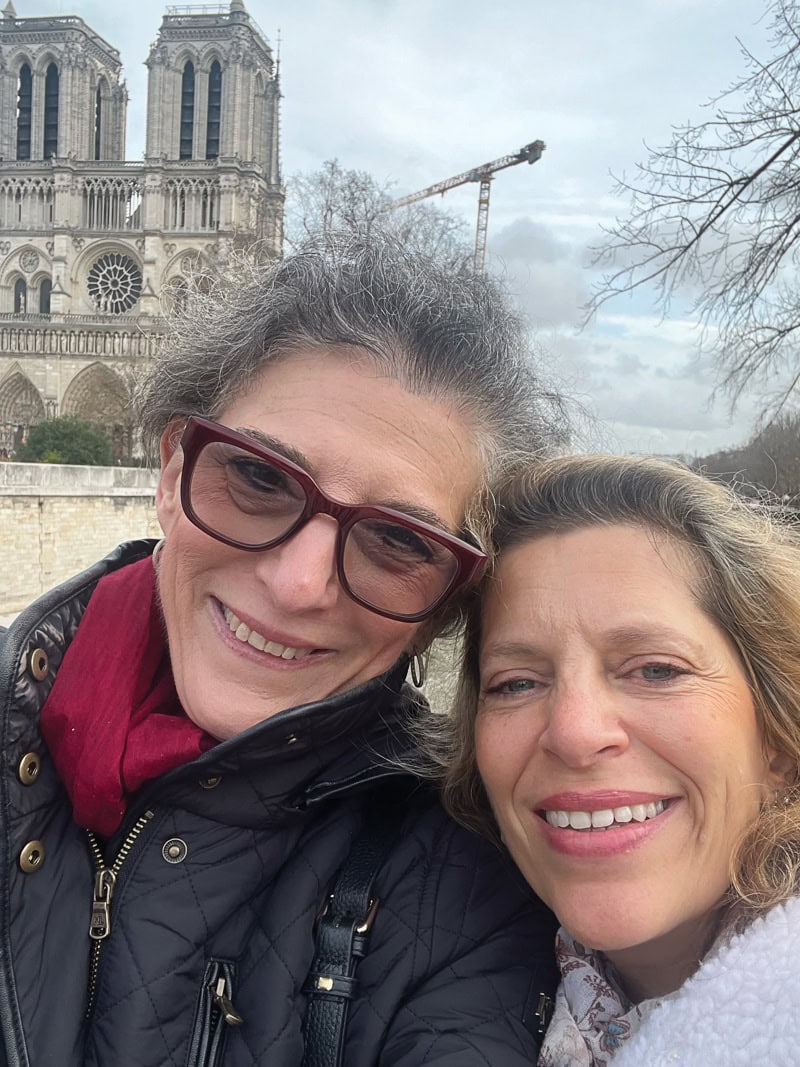
I stayed with my second cousin, Anne-Emmaneulle and her husband Olivier in their apartment in Versaille and, immediately, I felt like I had known her all my life. She was more like a sister than a cousin; we had so many things in common in terms of our values, feelings about family, and likes and dislikes, that we became fast friends. Thanks to Linda Fox-Jarvis, who provided me with an amazing itinerary for what to do in Paris if you only have one week, I was able to see so much of the city on my own, while my cousins were at work. What a beautiful city.
But the most moving part of the trip was meeting my dad’s first cousin, Phillipe, who is not in good health; neither of us could believe the miracle of our reunion and it was hard to let go of our embrace of one another. It was a heartwarming meeting, and I learned much about my father’s family of origin and the beautiful life they had led before 1944. I met my other second cousin, Benjamin, Anne-Emmanuelle’s brother, a well-known actor, director and producer of theater and opera, and Anne-Emmuelle’s daughter, Helen, and step kids, Julien and Tibaud. And we celebrated several times the wonder of being together after 80 years of separation. My only regret was that my father wasn’t alive to witness the miracle himself. But I knew I was meant to pick up his story where it left off and I was!
The hardest part, of course, was saying goodbye, but plans are already in the works for a reunion, this time with a trip to the south of France where my family has a country home in the area that hid and saved Phillipe, as well as a trip to Malam and Cluj, the Transylvanian village and city from where half of my family comes. This is a story with much more meaning and joy to unfold and I intend to live it for the rest of my life.
In this secular new year, I pray that each of us is willing to risk the unimaginable rewards that opening one’s heart and taking a leap of faith can bring, a year of health, fulfillment, joy, and peace.
Rabbi Rosalin Mandelberg is the senior rabbi at Ohef Sholom Temple. This story was excerpted from a sermon delivered in late December 2025.