Tuesday, Jan. 27, 7 pm, Sandler Family Campus
For International Holocaust Remembrance Day, German historian Thomas Kemper will visit Tidewater to speak about his discoveries while investigating the history and fate of the Gonsenhauser and Bachenheimer families during the Holocaust – the families of Tidewater’s Mark Gonsenhauser and Joan Joffe.
Among the many stories he will share, Thomas will talk about Augusta Gonsenhauser’s last weeks during which she was transported to and murdered in Estonia, as well as history on Helmut Gonsenhauser and his half-brothers, and the shocking truth about Helmut’s childhood friend who turned out to be a rabid Nazi. Thomas will reveal some of the documents he unearthed such as a letter from Helmut’s father to the school principal begging in vain for him to allow Helmut to stay at the school. Thomas will also explain why, as a Catholic, he became so interested in what happened to the Jews of the neighboring towns during the Nazi era, especially that of the Gonsenhauser family. How Thomas met and became friends with the Gonsenhausers and his personal struggle to understand the entire tragedy, will also be disclosed.
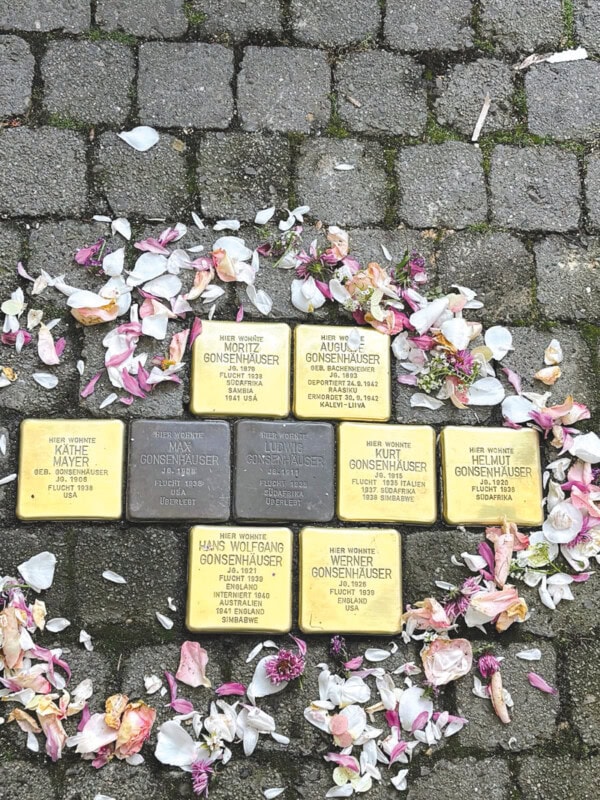
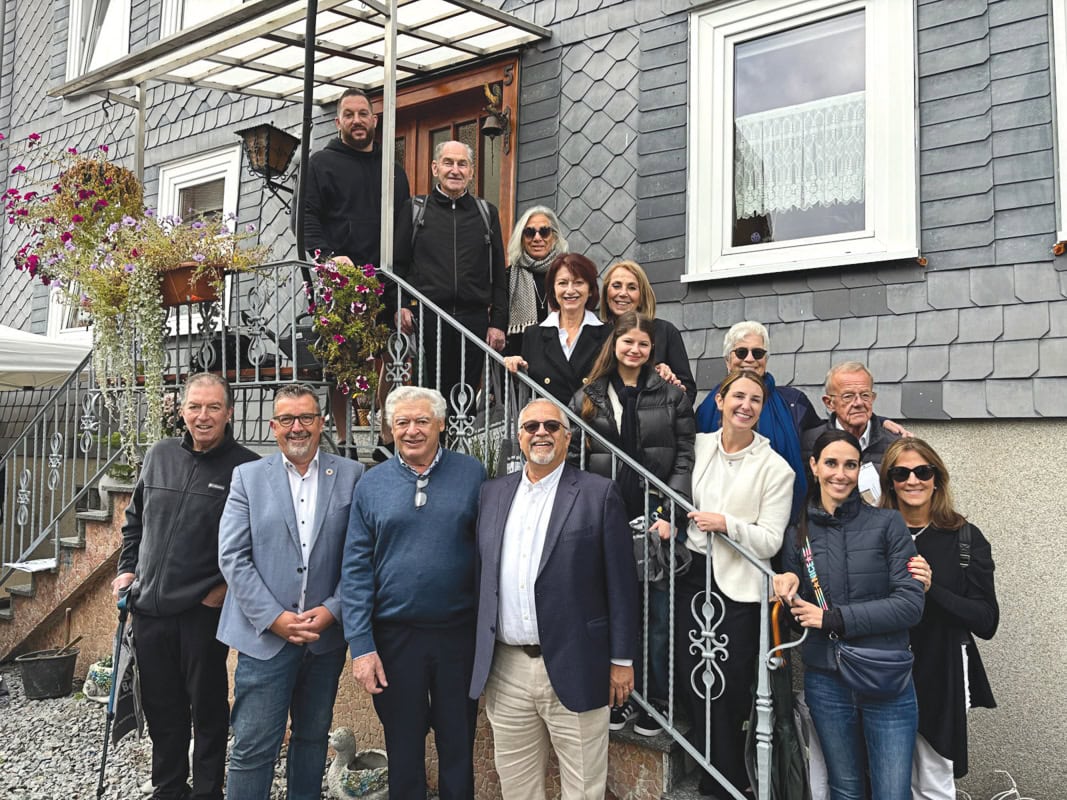
In late September 2024, members of the Gonsenhauser family, travelling from various countries, met in Frankfurt, Germany to start an amazing journey organized by Thomas. The culmination of the trip would be at the laying of seven Stolpersteinen (stumbling blocks) outside the house originally occupied by the Gonsenhauser family in the small Northern German town of Bad Berleberg. Stolpersteinen have metal plaques attached to them, and they replace cobble stones outside houses previously occupied by Jewish families who left Germany or were murdered during the reign of the National Socialists (Nazis). They can be seen in many cities and towns throughout Europe. Each Stolperstein has the name and fate of individual family members inscribed on them.
Everyone had arrived at the Frankfurt hotel by the morning of September 20 and was handed a beautifully produced booklet containing hour by hour details of the journey we were about to embark on. Produced by Thomas, the booklet was typical of the care and time he put into every aspect of his research into the Gonsenhauser family. The booklet also contained more than 30 pages of Gonsenhauser history. For that first day, Thomas had arranged for an afternoon tour to what had been a huge covered market that was also used as an assembly point for the deportation of Frankfurt’s Jews. The part of the building – underground and empty and eerily quiet – where the doomed Jews were assembled, is now a memorial to those lost. Thomas arranged for a member of the Jewish museum to lead the tour.
The next day, Thomas took us to the site of the Jewish hospital where Augusta Gonsenhauser worked. Augusta Gonsenhauser (nee Bachenheimer) was the third wife of Moritz Gonsenhauser (Joan Joffe and Mark Gonsenhauser’s grandfather). Augusta’s sister, Johanna Gonsenhauser (Joan and Mark’s grandmother), had died giving birth to Joan and Mark’s father, Helmut. We also visited the Jewish children’s home where Augusta’s son, Werner Gonsenhauser, had lived. By coincidence, this building was close to the Frank family home before Anne, her sister, and parents fled to Holland.
On the third day, we departed Frankfurt and drove to our next hotel in a small town called Oberkirchen. On the way, two of our stops were at buildings in separate towns where Helmut Gonsenhauser had served his apprenticeships. Later that day, Thomas gave an organ recital in memory of Augusta Gonsenhauser.
The next day, we went to the small town of Wetter where we visited the old synagogue, now a museum, displaying artifacts donated by descendants of the Bachenheimers who had lived in the town. We also visited the nearby Jewish cemetery where Bachenheimer ancestors were buried in the late 19th and early 20th centuries.
On the fifth day, we made our way to the town of Bad Berleberg for the laying of the Stolpersteine. A large contingent from the local population attended, including the press, with TV cameras. The town’s mayor addressed the crowd, and high school students sang Shalom Chaverim, which touched us all. There, we visited a school which Helmut Gonsenhauser attended, as well as two local cemeteries, which contain the graves of many Gonsenhauser ancestors.
The following day, we toured the larger town of Schmallenberg which is near Oberkirchen and Bad Berleberg, where we also saw some Stolpersteinen dedicated to family members, and the Synagogenstrasse memorial.
Thomas Kemper’s presentation on January 27 offers Tidewater the chance to witness this history through the eyes of the researcher who revived it. His work reminds us that remembrance is more than reflection—it is an effort to restore dignity, confront truth, and ensure these stories continue to guide future generations.
For more information and to register, visit jewishva.org/IHRD, or contact the Holocaust Commission. The program is free.