
For more than two years since October 7, the Jewish world has continued to grapple with grief, anger, fear, and deep internal division. Conversations about Israel and the Palestinians have strained relationships, fractured communities, and tested leadership at every level — especially on college campuses, where the next generation is forming its understanding of identity, history, and responsibility.
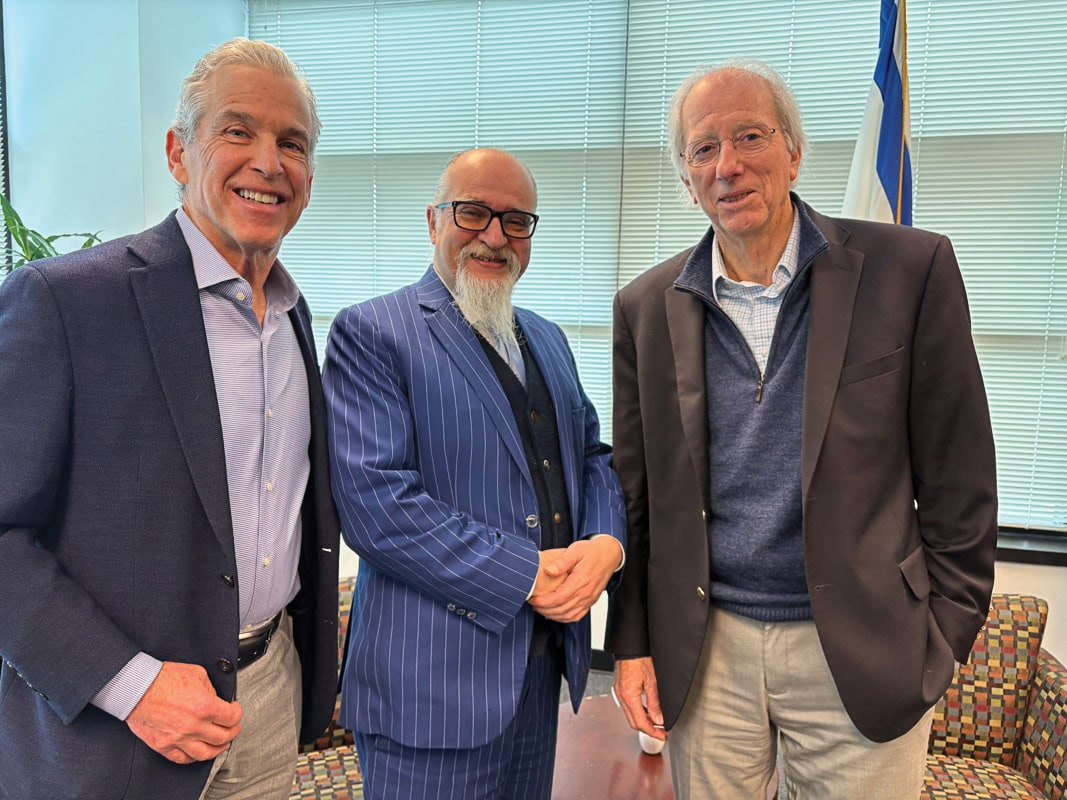
In late February, members of Tidewater’s Jewish community leadership had the opportunity to be part of a conversation about Israel, the Palestinians, and the responsibility of Jewish leadership with Ambassador Dennis Ross and Ghaith al-Omari.
Ambassador Ross is the counselor and William Davidson Distinguished Fellow at the Washington Institute for Near East Policy. He also teaches at Georgetown University’s Center for Jewish Civilization. For more than 12 years, Ambassador Ross played a leading role in shaping U.S. involvement in the Middle East peace process, dealing directly with the parties as the U.S. point man on the peace process in both the George H.W. Bush and Bill Clinton administrations.
Ghaith al-Omari, the Rosalinde and Arthur Gilbert Foundation Senior Fellow in The Washington Institute’s Irwin Levy Family Program on the U.S.-Israel Strategic Relationship, is the former executive director of the American Task Force on Palestine. He served as advisor to the negotiating team during the 1999–2001 permanent-status talks in addition to holding various other positions within the Palestinian Authority.
Ross and al-Omari have spent decades navigating the hardest dimensions of Israeli-Palestinian negotiations. Today, they travel together to campuses across the country, modeling informed, principled disagreement —
demonstrating that it is possible to engage complex realities without abandoning nuance, mutual respect, or intellectual rigor.
In this serious, candid, and policy-grounded conversation about what comes next, moderated by Jay Klebanoff, the men fielded questions on topics such as:
• The current strategic landscape in Israel and the Palestinian arena,
• Realistic scenarios for the months and years ahead,
• Lessons learned from past negotiations, and
• Strategic insights on campus trends.
Ross and al-Omari spoke about how slogans have become substitutes for thought, and that most peace activists are not really about peace, but rather about “no Israel.”
They also highlighted the two realities on Gaza. Israelis saw hostages and the death of soldiers, while everywhere else witnessed the death and destruction in Gaza.
At a time when voices are often amplified by outrage, this gathering presented a new perspective and appreciation for the ability to learn from each other.