
Rosh Hashanah arrives each year carrying questions.
What did I accomplish during the year that has passed? Where did I fall short? Whom did I help? Whom did I hurt? What needs to change?
But beneath all these questions lies another, more fundamental one:
Who am I?
The easiest answers are usually the most immediate: our names, professions, accomplishments, relationships, and responsibilities. We introduce ourselves by describing what we do, where we live or to whom we belong.
These things are important, but they are not the whole story. Jobs change. Titles disappear. Success comes and goes. Even the roles we treasure most may change with time.
Rosh Hashanah invites us to look beneath those temporary descriptions and encounter the deeper self—the soul that remains when the titles and achievements are stripped away.
Jewish tradition suggests that this soul is formed through relationship: our relationship with family, with community, with other human beings, and with God.
The Torah teaches, Lo tov heyot ha’adam levado—“It is not good for the human being to be alone” (Genesis 2:18). Family is not merely an accessory to life. It is one of the principal places in which the soul is formed. It is where we first learn to give and receive love, to disagree, to forgive, to make sacrifices, and to care for someone beyond ourselves.
Family, of course, is not only biological. There are families we inherit and families we create. There is also the extended family of the Jewish people—a people bound together by memory, responsibility, and a story that began long before us and, God willing, will continue long after us.
A beautiful midrash (Shir HaShirim Rabbah 1:4) teaches that when God prepared to give the Torah at Mount Sinai, God asked the Israelites to provide guarantors who would ensure its continuity. The people first offered their ancestors and then their prophets. Finally, they said, “Our children will be our guarantors.”
God accepted.
The message is powerful: Jewish identity cannot survive only as a memory of the past. It survives when we place it into the hands of the future. Our children become our guarantors when they see that Judaism matters to us—not only in what we say, but in the lives we lead.
Faith forms another part of this deeper identity.
The Torah says: “The word is very near to you, in your mouth and in your heart, so that you may do it” (Deuteronomy 30:14). Faith is not necessarily found in dramatic miracles or perfect certainty. It can live in prayer, gratitude, doubt, and even complaint.
After all, complaining to God may itself be an expression of faith. It means that somewhere within us, we still believe someone is listening.
The Talmud (Ta’anit 25a) tells a remarkable story about Rabbi Hanina ben Dosa, a man who lived in profound poverty. In response to his prayers, Heaven granted his household one leg from a golden table. Later, however, his wife dreamed that in the World to Come everyone else sat at complete tables while theirs was missing a leg. Rabbi Hanina prayed again, asking that the golden leg be taken back.
The story is not teaching us that poverty is inherently holy or that material needs are unimportant. Judaism does not romanticize suffering. Rather, it challenges us to consider how we measure abundance.
Pirkei Avot offers a different way of measuring abundance: “Who is rich? The one who rejoices in what they have” (4:1).
True wealth is not determined only by what we possess. It is also found in the people we love, the values we transmit, the good we bring into the lives of others, and the ability to recognize blessings before they disappear.
At the end of life, Pirkei Avot teaches, neither silver nor gold accompanies us. What remains are our acts of Torah and kindness.
What we accumulate eventually belongs to someone else. What we plant within another person can continue growing for generations.
This brings us back to the shofar.
The central mitzvah of Rosh Hashanah is not simply to blow the shofar, but to hear its voice. This year, because the first day of Rosh Hashanah falls on Shabbat, we will wait until Sunday to fulfill that mitzvah. Perhaps the waiting itself can prepare us to do more than hear a sound. Perhaps it can prepare us to receive its message.
The shofar has no vocabulary and offers no explanation. It speaks through breath, broken notes, and silence.
The tekiah is whole and confident—the sound of the person we hope to become.
The shevarim is fractured—the sound of disappointment, grief, and the awareness that something within us needs repair. The teruah trembles—the sound of a human being struggling, searching, and refusing to give up.
Finally, we return to the long, unbroken sound of tekiah. Yet it is not the same sound we heard at the beginning. We have passed through brokenness. We have acknowledged our imperfections. The final tekiah is not the sound of innocence, but of resilience.
The shofar does not ask about our résumé. It does not ask how impressive we appear to others. It asks whether we are awake.
Are we present for the people who need us? Are we transmitting Judaism to the next generation? Do our actions reflect the values we claim to hold? Are we so busy building a successful life that we have forgotten to build a meaningful one?
Perhaps our identity is not something we discover once and possess forever. It is something we create through every relationship, decision, and act of responsibility.
This Rosh Hashanah, when we finally hear the shofar, may we allow its voice to become a mirror. May it remind us that we are more than our titles, possessions, successes—and even our failures.
And when the new year asks, “Who are you?” may we be able to answer:
I am a soul still growing.
I am part of a family and a community.
I am responsible for what I transmit to those who come after me.
I am connected to God, even when I question, struggle or complain.
I am a member of Am Yisrael.
And I am ready to begin again.
Shana Tovah!
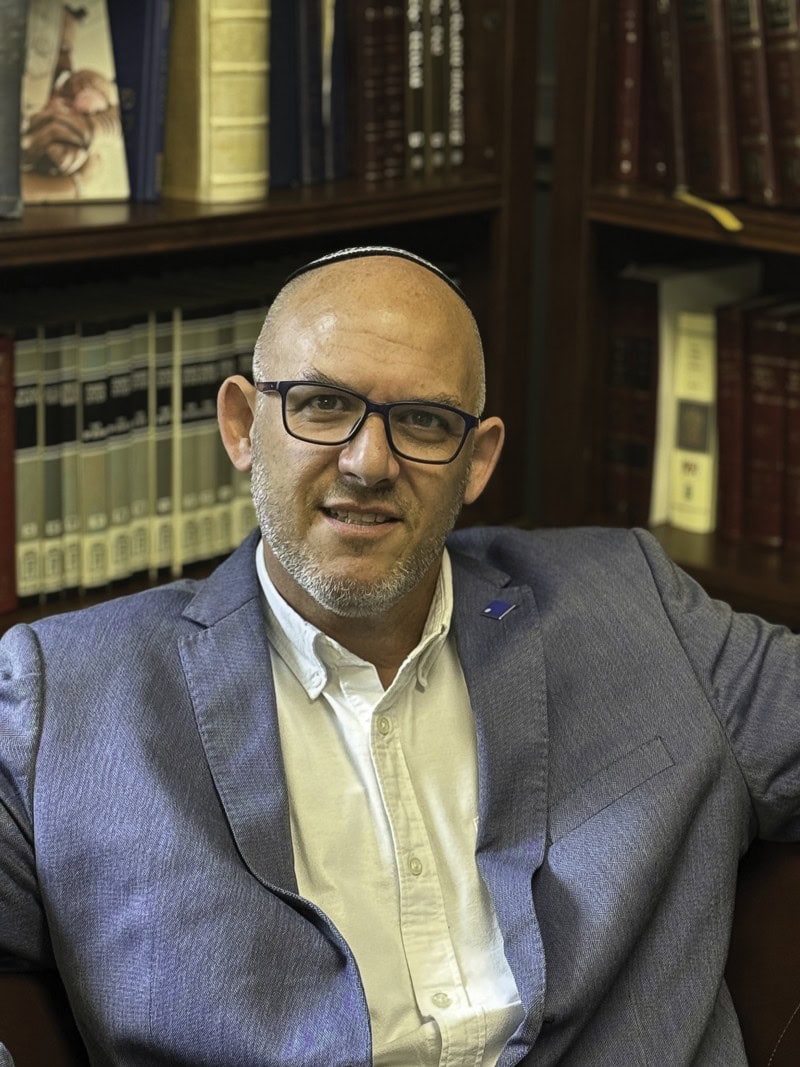
Rabbi Ari Oliszewski, Temple Emanuel Virginia Beach