Commentators across the political spectrum have expended countless words to describe and explain the current moment in Israel and the state of the U.S.-Israel relationship.
In Tidewater last month, Michael Oren, Israel’s ambassador to the United States (2009-2013), member of the Knesset (Israel’s parliament), professor at leading American universities including Harvard, Yale, and Georgetown, and author of several best-selling books, structured his commentary about Israel through a single, Hebrew word as rendered in English, “davka.”
Davka is a word without a synonym in the English language, Oren said. It means doing something unexpected or contrary to what might be expected in a given situation. Or, as Oren put it more colloquially: “Doing something precisely the opposite, just because.”
Oren spoke on Thursday, Oct. 22, at Congregation Beth El as the synagogue’s Milton “Mickey” Kramer Scholar-In-Residence. His speech was a double kick-off event, commencing the United Jewish Federation of Tidewater and Simon Family JCC’s Lee & Bernard Jaffe Family Jewish Book Festival, and the start of the 16th Annual Israel Today series, a partnership of UJFT’s Jewish Community Relations Council and community partners, including all area synagogues.
Oren was born in the United States but immigrated to Israel in 1979; he eventually renounced his American citizenship in 2009, in order to serve as Israel’s ambassador to the United States, since Israeli law prohibits someone with dual citizenship serving in the post. He received much of his education in the United States, including an undergraduate degree at Columbia, and a doctorate in Near Eastern Studies from Princeton.
In his prepared remarks, Oren argued that the entire history of the Jews can be understood through the lens of davka. From the very beginning of Judaism, when Abraham rejected idol worship and chose instead to worship an invisible God, “that was davka,” he said. Through thousands of years of history, from escaping slavery in Egypt to building a new nation after genocide – all of it, Oren said, is davka.
That includes the current moment, with Israel’s ongoing response to the brutal attack by Hamas on Oct. 7, 2023, killing 1,200 men, women, and children, and taking 251 as hostages. Even as Israel carried out its response in Gaza, Oren noted, the Israeli military operated under rules of engagement that showed a value for human life. He listed several of those: deploying leaflets to warn Gazans to move before military strikes; canceling planned strikes on Hamas if too many civilians would be killed; and providing food for the Palestinians, even when terrorists were stealing some of it.
Oren said that even as the situation in Israel is extraordinarily serious, Jews around the globe are facing something equally serious – antisemitism, or as he put it more bluntly, “Jew hatred.”
“It is very painful for me,” he said, “the very sharp decline in the polls of the support for Israel.”
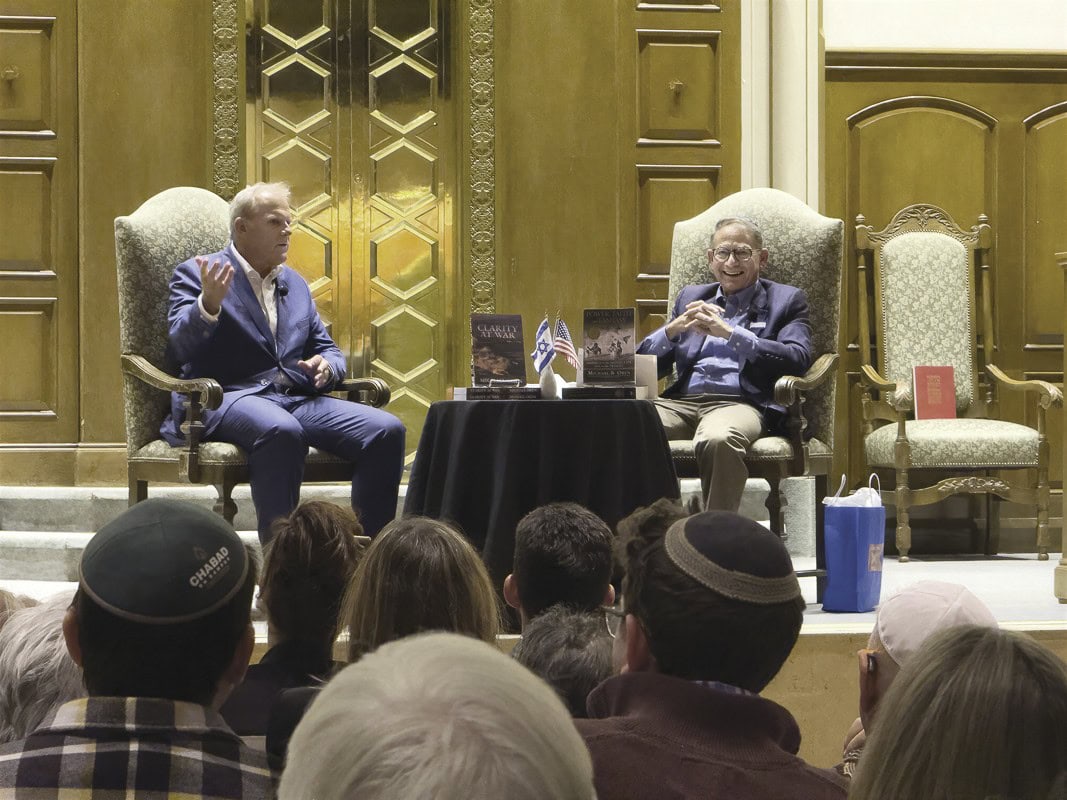
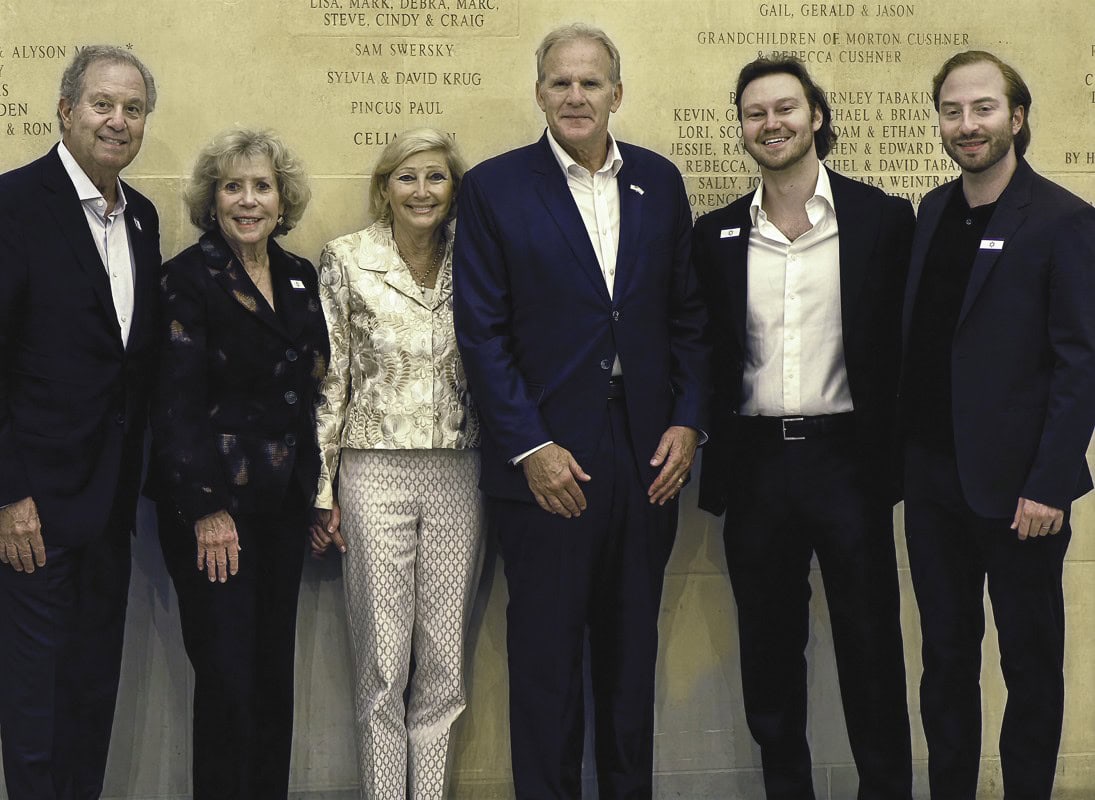
Oren was introduced by Vice Admiral Herm Shelanski, USN (Ret.), who is immediate past president of Congregation Beth El. The two men have a long and deep friendship, which began when Oren was part of a formal delegation that came aboard the USS Harry S. Truman on which Shelanski served as the commanding officer, during Operation Iraqi Freedom. They also recently worked together in Verdun, France, for Operation Benjamin, an initiative to identify the graves of Jewish American and Allied service members from World War I and World War II who were mistakenly buried under incorrect religious markers and replace those markers with Stars of David.
Shelanski moderated a Q & A session after Oren’s talk with questions from the audience. Several questions touched on the then upcoming election in Israel, where Benjamin Netanyahu, who has served as Israel’s prime minister for 19 years over three separate periods, the most recent one dating from Dec. 2022, faced stiff opposition.
While Americans, both Jewish and not, are very concerned about the War in Gaza and the situation in the West Bank, neither of those were central issues in the upcoming election, Oren said. Perhaps surprisingly, the war with Iran is also not a source of controversy. Rather, he said, two other issues dominate Israelis’ concerns: Will there be an independent state commission to investigate the failures that led to the October 7 attack? And, secondly, will the nation end the exemption on military service for the ultra-orthodox Jews?
Regardless of the outcome of elections in Israel and the United States, Jews in both countries need to understand “that we are one people,” Oren said. “Our destinies are tied up with one another. Together we can overcome anything. We are the ultimate resilient people.”
Esther Diskin is a member of the Jewish Community Relations Council and serves on the board of Ohef Sholom Temple.