
Every year on the 25th of Kislev, Jewish homes around the world are filled with the glow of the hanukkiah, a Hanukkah menorah. The eight-day festival recalls the second-century BCE victory of the Maccabees over the Seleucid Empire, whose ruler had outlawed Jewish practice and desecrated the Temple in Jerusalem. After the Maccabees retook and rededicated the Temple, according to the story, a single day’s supply of pure oil burned for eight days. Hence, the custom of lighting a candle for each of the eight days in a Hanukkah.
Millenium later, these four locals share what makes the menorahs or hanukkiyot they light each Hanukkah so special. From handmade clay to heirloom brass, these menorahs hold special meaning to all their keepers, regardless of the form they take.
Barbara Dudley
The crooked hanukkiah
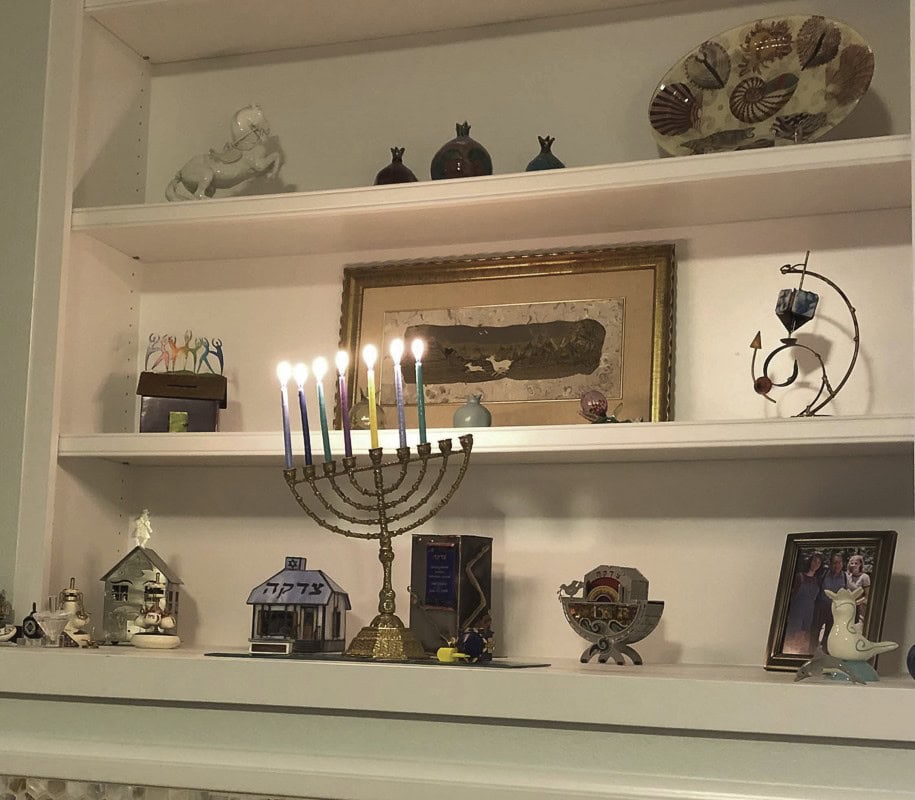
When Barbara Dudley married her late husband, Noel, in August 1976, her parents gave the couple a large, traditional brass menorah made in Israel. It became part of their yearly celebration. “I always loved the glow of its candles,” she says.
In late September 2010, after her father died, the Dudleys held shiva at home. Friends had gathered to share stories, eat, and form a minyan when a loud crash echoed from the dining room. Dudley rushed over, afraid something had fallen on a guest. No one was hurt, but the menorah lay on the tile floor, bent at an angle.
Rather than viewing it as a loss, she saw the change in the menorah’s structure as proof of her dad’s presence, a reminder of the little pranks he used to pull around the holidays. She named it “the Crooked Menorah” on the spot, and she and Noel chose to leave it as it was. Each Hanukkah afterward, they lit it to celebrate the miracle of the holiday, remember her father, and recall a moment she calls “poignant yet humorous.”
This Hanukkah, she will light the Crooked Menorah alongside two additions to her collection, representing connections old and new.
Kyleigh Eyl
A hanukkiah from Jerusalem without instructions
The earliest memory Kyleigh Eyl recalls of a menorah involves lighting it wrong.
Eyl grew up in Swansboro, North Carolina, in the Bible Belt, where almost no Jewish population exists. Neither of her parents is Jewish, but parts of her father’s side of the family are, including his grandmother, whose menorah became a family keepsake.
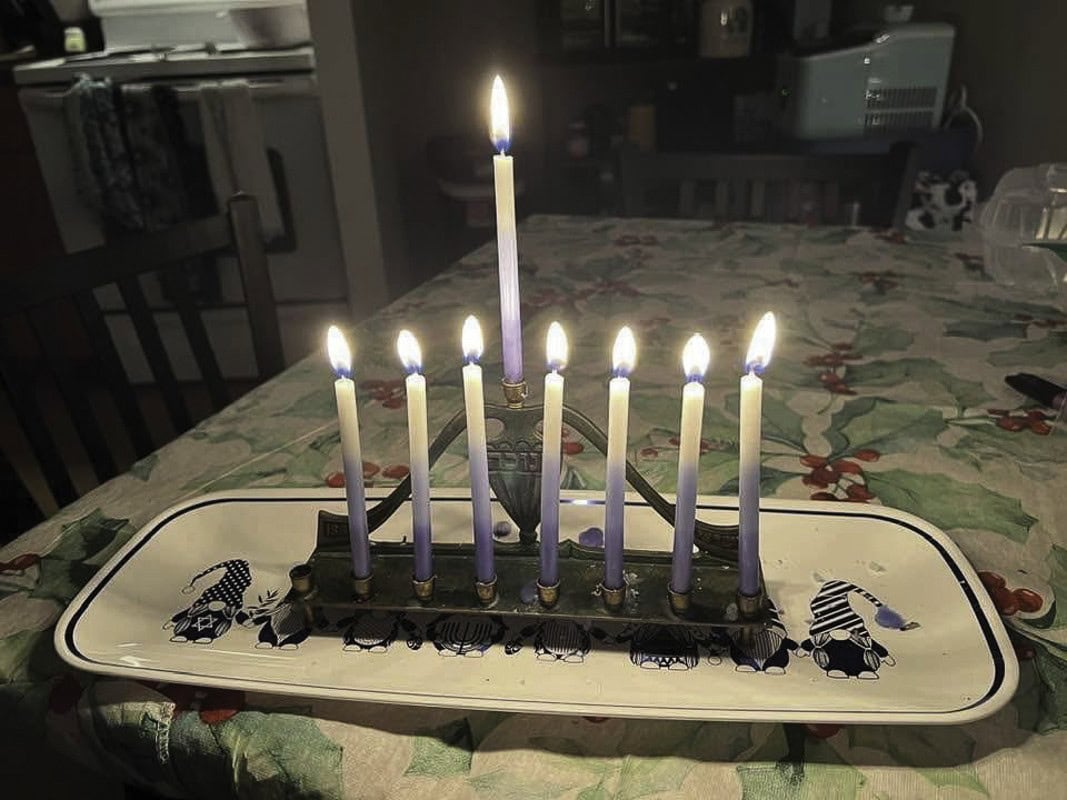
When Eyl was young, her family would put all the candles in and light them at the same time, because no one knew how it was meant to be done.
The menorah is greenish with gold candle holders, has Hebrew writing on it, and an emblem in the middle. “It’s like no menorah I’ve ever seen before,” she says. Her family says it came from Jerusalem.
Even then, Eyl says she felt “a crazy connection to Judaism.” She grew up going to Catholic religious classes on Sundays, but in college she was able to explore the religion that had always existed faintly in the background of her family life.
The first time she walked into a synagogue, Eyl says, she felt at home and at peace, and “that’s what I was meant to do.” She converted at Congregation Ahavas Achim, a small synagogue in Keene, New Hampshire.
The first Hanukkah after her conversion, lighting the menorah meant something new. Before, she says, “I’m just lighting the menorah to light it.” Now she says the prayers correctly and knows what they mean.
Eyl moved to Tidewater about a year and a half ago. She serves as coordinator of advocacy and community engagement for United Jewish Federation of Tidewater and is involved with Chabad of Tidewater and B’nai Israel Congregation in Norfolk.
Gary Bartel
Menorah illumines memories
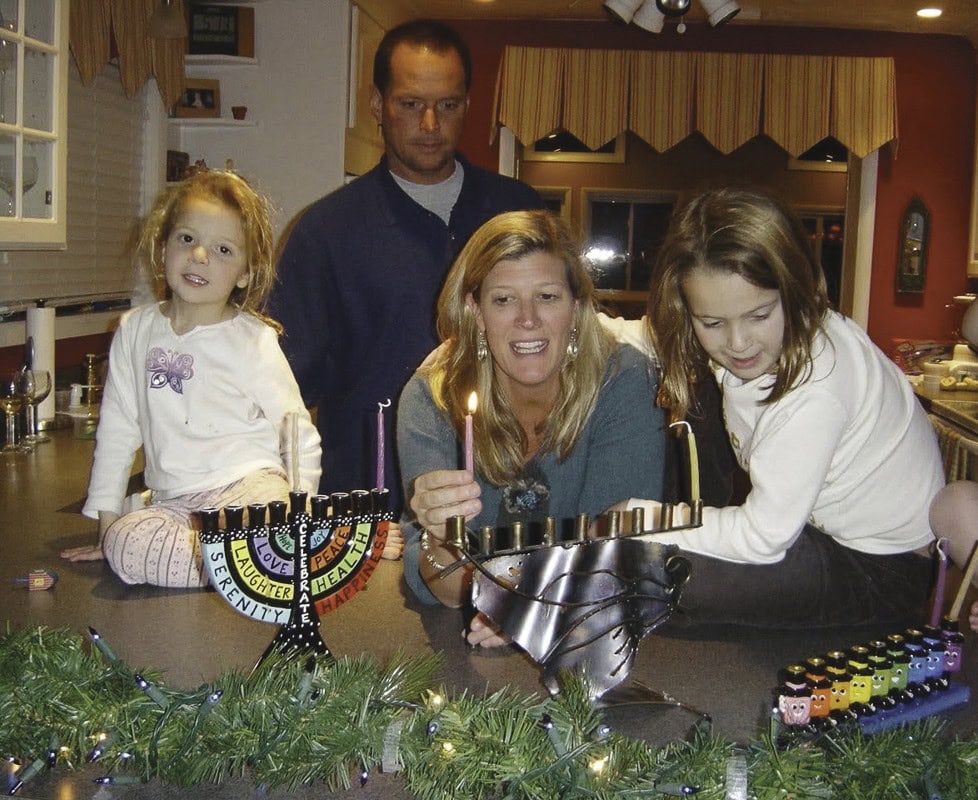
For Gary Bartel, the menorah that sits on his family’s table each Hanukkah is much more than a holiday decoration. Given to the family by his mother decades ago, it has been a constant presence through years of celebrations, milestones, and family gatherings. The silver menorah has illuminated Hanukkahs spanning multiple generations, from his children’s earliest years through adulthood.
While the menorah’s exact origins have faded with time – he guesses it was picked up on a ski trip to New Mexico or in the old gift shop at Ohef Sholom Temple – its significance has only grown. Bartel recalls his parents regularly joining the family for Hanukkah, gathering around the table to light candles, exchange gifts, and celebrate together. Looking at the menorah today, Bartel says he sees “a collage of memories.”
He remembers his children as young kids eagerly watching the candles being lit, learning the traditions of the holiday, and later celebrating as teenagers and adults. The menorah also reminds him of his parents, whose presence was a cherished part of the family’s Hanukkah celebrations for many years. “It’s sort of the reminder menorah,” Bartel says. “It gets me thinking about everybody.”
For him, the menorah has become a physical link to the people and moments that have shaped his family. Each Hanukkah, as the candles are lit once again, it serves as a reminder of the joy of being together and the generations of memories created around its lights.
Jill Bornstein-Hyman
Menorahs with faces
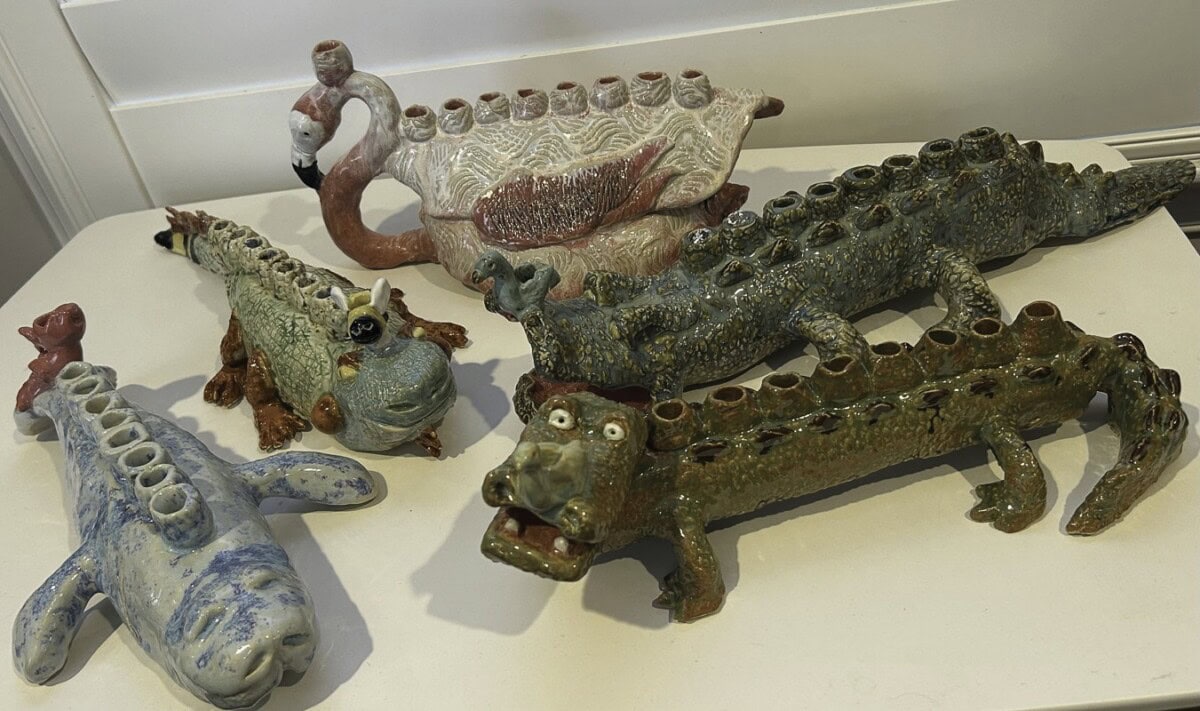
Animals are the focus of Jill Bornstein-Hyman’s menorahs. Her handmade clay pieces take the form of alligators, iguanas, flamingos, manatees, camels, lions, giraffes, dogs, and cats, while their eyes and expressions are shaped to look like a person’s: surprised, delighted, comforted, mischievous, or silly.
Bornstein-Hyman, a mother of five and a grandmother to two-year-old Shoshana, was born and raised in South Florida. It’s no surprise then, that her earliest pieces reflect her love of the Everglades and its wildlife. She began making menorahs after the loss of her mother, finding the process to be therapeutic. For her, the pieces are a way to share part of herself with her family and community – “l’dor v’dor,” from generation to generation.
“Everything I make in the studio has to do with Judaica,” she says. “Creativity and Judaism, to me, are very intertwined.” Living in Williamsburg, Bornstein-Hyman says she is mindful of creating visible expressions of Jewish identity.
“Making menorahs also gives an opportunity for us to be represented,” she says. “You can’t walk into a store and just buy a menorah off the shelf necessarily.” Each piece, she says, is deeply personal. “No two (of her) menorahs are the same,” she says, because each is “Avodat Yad,” handmade, and shaped by whatever inspiration emerges when she sits down at the wheel.
The whimsy, of course, comes with rules. Bornstein-Hyman follows halachic guidance, setting the eight candle holders in a straight line at the same height and making the shamash visually distinct and positioned at a different height. Doing so is harder than it sounds because clay shrinks during both the bisque and glaze firings. She also spaces the candles so each flame can shine independently.
Whether depicting a Florida alligator or a playful lion, Bornstein-Hyman hopes her work creates connection. “I want Jewish children to feel like they’re not left out,” she says. She hopes the pieces bring “laughter and smiles,” along with joy, pride, and a sense of belonging.