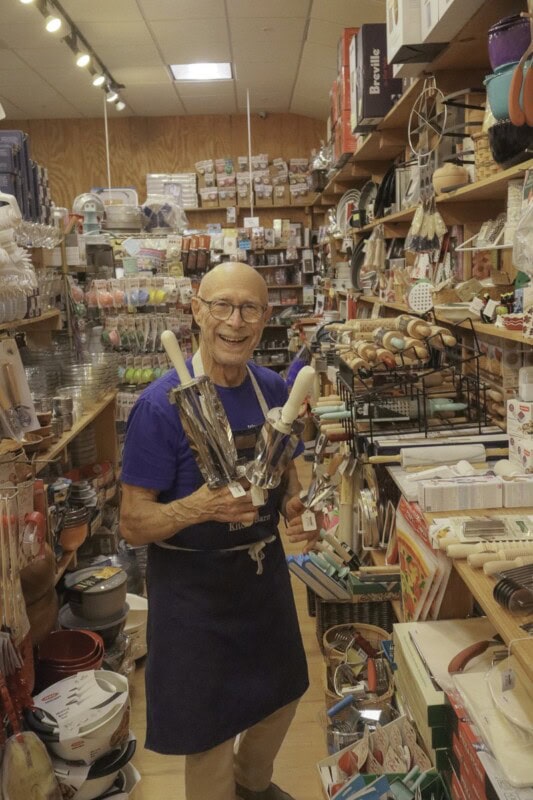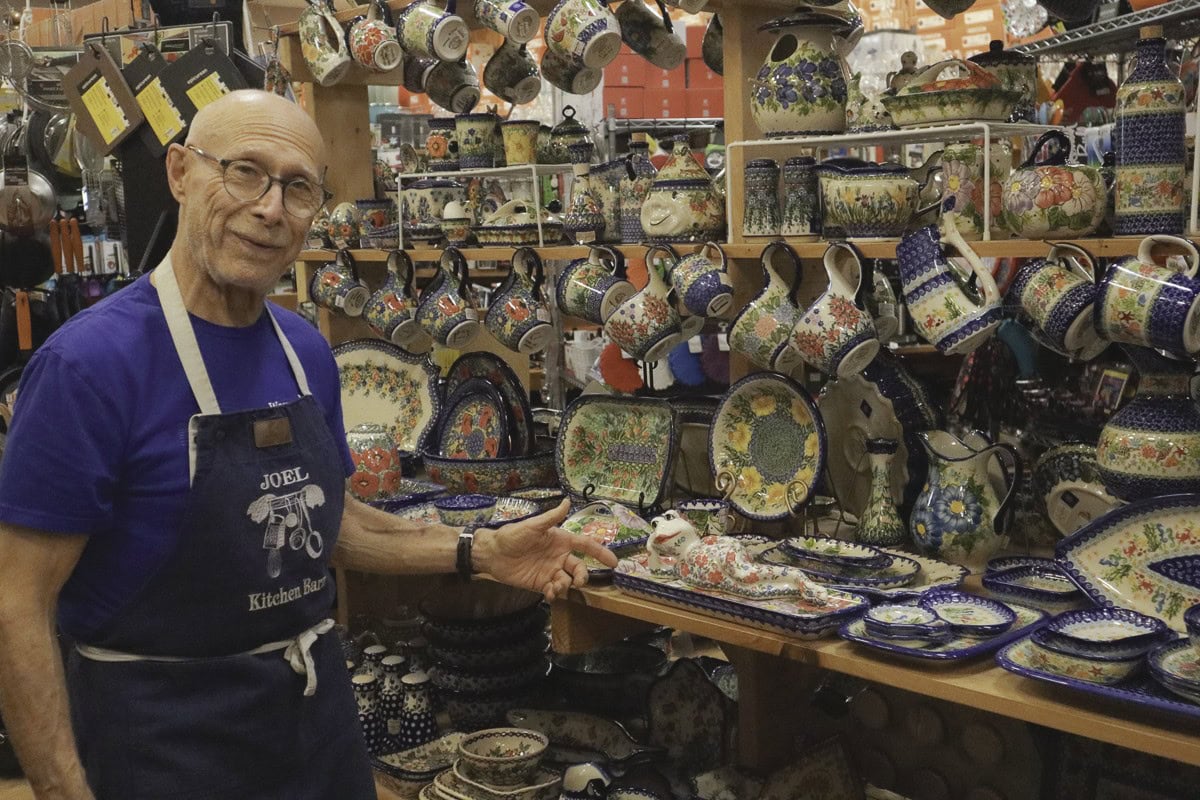
It doesn’t take much to keep Joel Feldman motivated to go into work every day. His store is his sanctuary, a culmination of half a century of hard work. “When my car pulls in the parking lot, I’m excited,” he says. “Sometimes I get chills. I’ve also broken down in tears.”
Feldman, founder of Kitchen Barn, has been selling cookware in Hampton Roads for more than 50 years. He considers his business, lifestyle, and the people it has brought into his life to be nothing short of a blessing.
Feldman grew up in Norfolk, around grandparents who spoke only Yiddish and kept kosher. His parents spoke it too, and he picked up “every expression you could think of,” even if he never learned the language itself. His father, [Louis] Feldman, was “an amazing salesman” who taught him “how to talk to customers, how to be a mensch.”
His first jobs were cutting grass, shoveling snow and delivering the afternoon Ledger-Star, collecting payment door to door. Those gigs taught him the value of “a regimen, something you had to follow,” he says. He then went on to work at Esquire Naval Tailor, where he worked for Jake Friedberg, a “master businessman.”
Eventually, he began cooking meals for people in their homes, with his wife, Phyllis, handling cleanup. He found that the pans folks kept in their homes, Club Aluminum, were “maybe a little bit of a poison,” noting that they “discolored and flavored food.” Then, in 1972, when a friend introduced him to stainless steel cookware, he realized he had work to do beyond just cooking.
Feldman wanted to spread the knowledge he’d uncovered, so he started selling the pans at cooking parties. “People would invite friends over, and I’d cook a dinner with these amazing pans,” he says. Eventually, he decided he wanted to open a store. “My main objective was to have better quality cookware.”
Before opening his store, a tip sent him to Washington to see Kitchen Bazaar on Connecticut Avenue. He walked in with a pen and paper and started taking notes. When the owner, Sherman Shapiro, arrived, Feldman introduced himself and explained his plan. Shapiro let him look around, took him to lunch, and told him exactly where to go in New York to find vendors.
“I was there the following week,” Feldman recalls. “That’s how it started.”
His first store opened in Pembroke Meadows on Independence Boulevard, and at the start, he had dreams of expansion. In 1976, developer John Ray Potter walked him through a staked-out lot at Hilltop and offered a 2,000-square-foot space.
By the time the 80s rolled around, he had three stores, including one in Coliseum Mall in Hampton, and had plans to open stores in Charlottesville and Washington, DC. Then, in 1983, interest rates hit 26 percent. “All I could do was pay the interest, forget paying on the principal,” he recalls. He closed Hampton and Independence Boulevard, designating his Hilltop store as the pièce de resistance.
He called every vendor he owed and asked to buy merchandise COD while paying down his debt monthly. With his wife’s agreement, he took a second mortgage. “Everyone said, ‘We’ll do anything we can.’” The remaining store thrived, and he paid everyone back, though he quickly realized 2,0000 square feet wasn’t enough for his extensive inventory. After 35 years in his original Hilltop North location, he moved to a larger spot just across the parking lot.
His setbacks taught him much about the keys to success. “Never give up. Work smarter. Learn from your mistakes. Listen to people, and always want to be better,” he says.
Feldman also attributes Kitchen Barn’s success to his staff, who spend six months learning before they talk to customers about cookware or knives. “I could never have done it without the wonderful people who work for me,” he says. “They all love what they do. They’re knowledgeable. Our idea of helping somebody with an item is to teach them the importance of the item.”
Kitchen Barn, Feldman says, offers an in-person shopping experience Amazon can’t match. “I’m a little mom-and-pop shop paying a fair amount of rent, and I pay my employees very handsomely,” he says. “I might be a few dollars more expensive, but when you buy from someone local, the money stays in town.”
He attends trade shows in Atlanta and Chicago each year, “always looking for a better mousetrap.” He offers cooking classes and always contributes to local schools’ raffles. His focus on maintaining a high-caliber inventory and remaining involved in the community easily sets him apart from other options.
“We have things that have been tested and been around for years, and we get better all the time,” Feldman says. “We’re good to our customers. We strive to have the best that we can have. And we always make sure we have good quality merchandise on the shelf.”
Such dedication has put Feldman in a place where he has served generations of families, a feeling he can only describe as heartwarming. One woman returned 15 years after he gifted her a child’s apron her mother couldn’t afford. “I’ve never forgotten you,” she told him, a memory he recalls with tears in his eyes. That kindness and generosity plays a big part in Kitchen Barn’s staying power.
With half a century under his belt, Feldman is over the moon about the future of Kitchen Barn. “We do a little better every year. Our figures are positive,” he says.
His granddaughter, Lauren, is expected to take over someday. During the 50th September sale, she noted that she would be 80 years old at the 100th September sale. “How sweet is that?” he asks rhetorically, beaming. No response needed.
Feldman’s advice for business owners starting out is simple: “Listen to that inner thing inside of you when you’re doing something. If it doesn’t make you feel good, don’t do it. It needs to be something that comes from your heart.”