Conservative Jews like me who have read from the Torah for years either memorize the words, vowels, and musical notes…or trope…or just manage to get through typically a handful of sentences from an eighth of a third of the sedrah or weekly portion (the triennial cycle it’s called) on Shabbat mornings.
But the guys on the Orthodox team chant all 304,805 words over the course of the year, an impressive achievement. Rabbi Levi Brashevitzky of Chabad of Tidewater is such a Baal Korei. After initially watching him from the gallery at the Chabad “House” (a former funeral parlor) on Colley Avenue, I asked, “how do you know the 27 tropes so well?” They are not on the parchment, but they are in the Chumash, which includes the entire text with translations, vowels, and trope. The congregants have copies of the Chumash at their seats, but more importantly, so does the one standing to the reader’s left. “Do you see what he’s doing?” queried Brashevitzky.
And so the next time I was at Chabad, I watched closely. While the Rebbe was zipping through the unadorned lines in the columns, in his peripheral vision was his human cue card, flashing him a set of signals. “When he sticks out his index finger at an angle, that’s a re-vi-i,” says the 48-year-old Brooklyn-born father of three. “An okay gesture with two fingers is a te-li-shi. A hard chop means ‘sohf pasuke,’ the end of the sentence.”
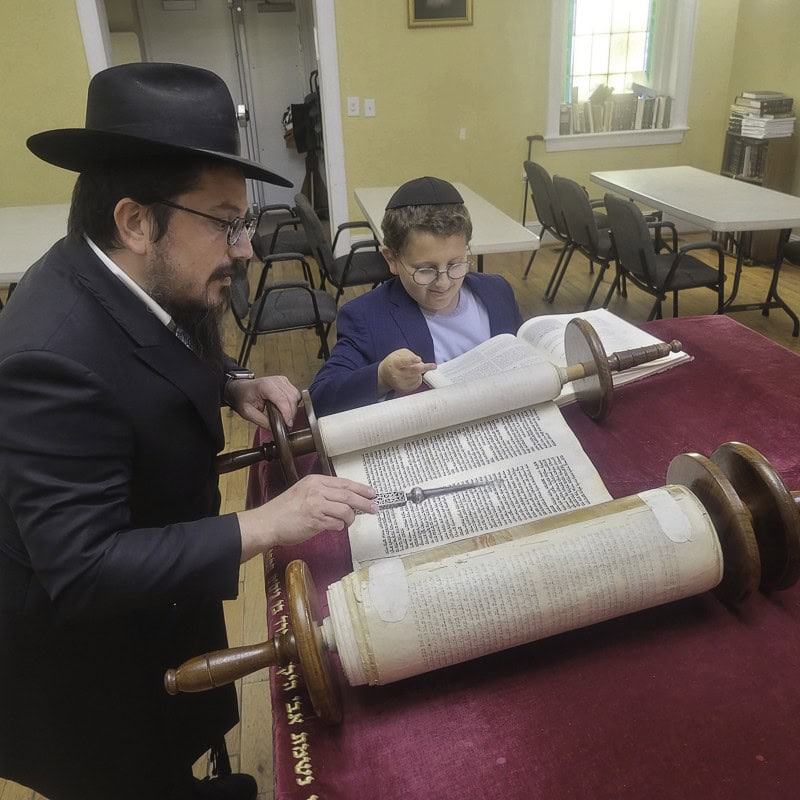
Larry Bublick, a longtime member, was Brashevitzky’s signal guy for years. His wife’s brother is an occasional sideman. The newest one, though, is his and wife Rashi’s (nee Margolin) flesh and blood, their youngest, Shaya Brashevitzky, freshly bar mitzvahed and now motioning pah-zairs and ti-veers like a pro on Saturdays.
So on a recent Thursday (not on a Shabbos), I had this proud abba and his ben meet me at Chabad for an interview, demonstration and photos. “Yes, I wanted to learn how to do the trope signals,” says Shaya. “I thought it was cool.”
In reality, it is not a sin to mess up a trope. “It’s the words that are most important,” says the learned Brashevitzky, and in most shuls of any denomination, there are minders in the pews ready to correct the reader when he blows a Hoo or a Hee.
“I don’t mind at all,” says the rabbi, “because the Torah is our story. Every letter, every paragraph has meaning.” As for the trope, Google says the Masoretes, a group of 10th century scholars living in Tiberias, Israel codified them. As to who devised the signals (www.learntrope.com/handSigns.html), “I don’t know,” says Brashevitzky, “but they work.”
Brashevitzky says he did not read the Torah at his own Bar Mitzvah and wasn’t aware of all the trope signing until his wedding weekend. Now it’s his vocation. In advance of each week’s “kriat ha torah,” he relies mostly on his own memory of the text and some minor prep each Friday afternoon.
Once he has yad in hand and a Cohain aliyah chanter over his shoulder, Brashevitzky depends on his signaler to keep pace with him (a couple words ahead actually), so the presentation seems seamless to the men and women on either side of the mechitzah (separator). And take it from this occasional Torah reader, no one tells the tale of the Five Books faster, clearer and more melodically than Rev Levi Brashevitzky
Rabbi Levi’s newest trope sidekick is his own 13-year-old son