
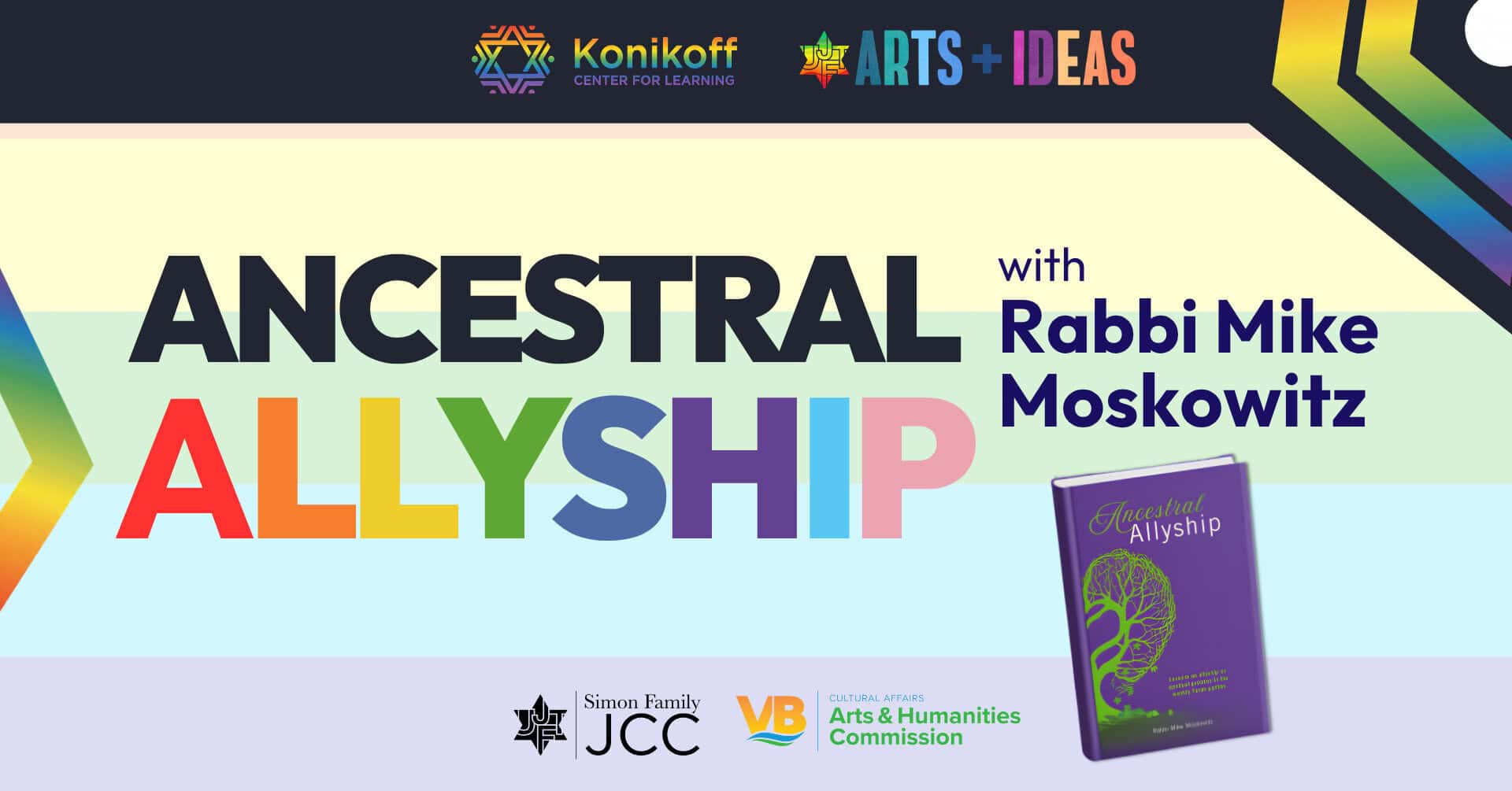
Wednesday, June 10, 7 pm, Sandler Family Campus
In his book, Ancestral Allyship, Rabbi Mike Moskowitz draws on the weekly Torah portion to explore allyship as a spiritual practice.
At its most basic, allyship is defined as the state or condition of being an ally; supportive association with another person or group. It is most often used in recent years to describe support or association with members of a marginalized group to which one does not belong.
Rabbi Moskowitz grew up in a family affiliated with the Conservative movement, holds three ordinations from two prominent Orthodox yeshivas, and most recently served a New York congregation unaffiliated with any movement.
That synagogue, Congregation Beit Simchat Torah, describes itself as the world’s largest synagogue committed to serving members of the LGBTQ+ community. Borrowing language from that community’s experience, he describes his religious journey as, “I was assigned secular at birth, came out and identified as ultra-orthodox, and now I’m some version of religious non-conforming.”
Moskowitz served the congregation for seven years as Scholar-in-Residence for Trans and Queer Jewish Studies, during which he published more than 130 articles and five books. A longtime advocate of teaching that all people are created b’tzelem Elohim – in the image of God – Moskowitz began speaking out publicly about LGBTQ+ issues in 2015. Until then, he had published blog posts with the Jewish LGBTQ+ organization, Keshet, under a pseudonym, and worked quietly with Orthodox families raising gay children. It just so happened at the same time he began speaking out publicly about his views, a family member came out as transgender.
In a 2022 interview with Tablet Magazine, Moskowitz said, “I was 37 years old at the time, and I had the same sensation I experienced at 17 when I became Torah observant, which is if I know this to be true, do I have enough faith to follow through with what I know is right and deal with the precarity and the consequences?”
He describes that moment as a turning point, one that led him to speak publicly and more directly about allyship. He now uses his knowledge of Jewish law, halacha, to guide others to do the same. For the Torah portion, Behaalotecha (Numbers 8:1-14), Moskowitz writes in Ancestral Allyship about Aaron feeling disappointed that he is not called upon to contribute to the tabernacle. He writes that, “knowing that we each have a special offering to share with the world encourages us to be open to the inspirational truths that are found in others.”
Comparing that to the act of allyship, he writes, “Celebrating pride is acknowledging that we each have love to give. By assisting the world in embracing the love of others, we are acting as a partner in the ongoing creation of a more connected and involved society that knows better than to hate what is different.”
Rabbi Moskowitz is speaking for United Jewish Federation of Tidewater’s second annual recognition of LGBTQ+ Pride Month. The event is presented by UJFT’s Arts + Ideas and Konikoff Center for Learning and funded in part by the citizens of Virginia Beach through a grant from the City of Virginia Beach Arts & Humanities Commission. It is held in coordination with the Jewish Book Council, Hampton Roads Pride, and the LGBT Life Center of Hampton Roads.
For information, contact Hunter Thomas, director of Arts + Ideas at UJFT, at HThomas@UJFT.org.