
It was just a day after the twin horrors of March 12 – the attack on Temple Israel synagogue in West Bloomfield, Mich. and the murder of an ROTC professor in class at Old Dominion University here in Norfolk – when I attended Friday night services in the Sinai Chapel at Ohef Sholom Temple.
I’m a semi-regular attendee, but on this occasion, I felt compelled to go to show that the violence of the previous day’s events could not be allowed to be a deterrent.
Still, I was on high alert.
So, it came as a surprise to me to find the regular police duo who provide security at the entrance showing no outward change in demeanor. They were as casually friendly as ever, ready with a warm greeting, an open door, and no bag search.
(They know you, I was later assured.)
Sitting in the chapel, I found my mind drifting. I scanned the room for exits. I wondered idly if the two exit doors on either side of the bimah, which lead directly to the parking lot, were operational. Would they open? Would they set off an alarm if used? How recently had they been tested? Which of the other exits would be safer to use?
The more I thought, the more I became concerned that I had no idea what action I should take in the event of “an active threat” – that’s the terminology used by Mike Goldsmith, former Norfolk police chief, now with the nonprofit Secure Community Network, and security advisor for United Jewish Federation of Tidewater. What if my uninformed actions contributed to endangering others? And, I thought, if I don’t know what to do, there must be others who also don’t know.
When I expressed my concerns in an email to Rabbi Roz Mandelberg the next day, I received an immediate response —- while she was on vacation, no less. She copied her response to our temple administrator, Jennifer Levin-Tavares, who pointed me towards an upcoming security briefing at First Presbyterian Church.
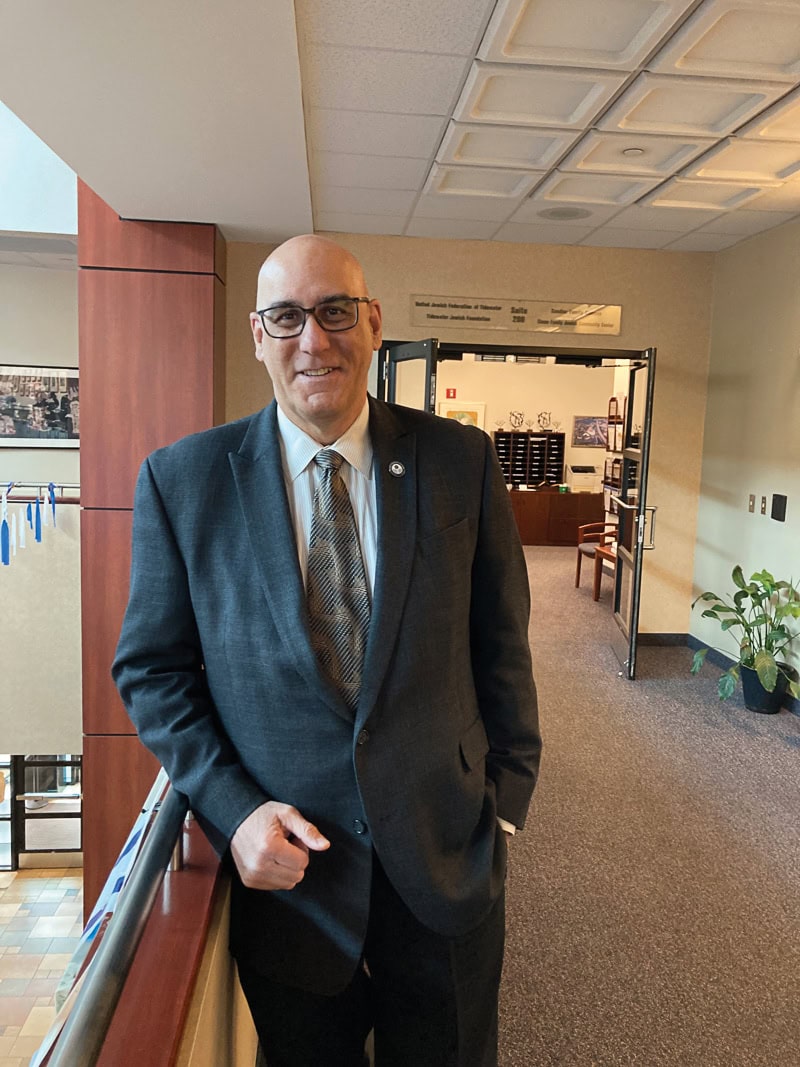
And that’s how I found myself inside in First Hall, on the left as you enter the church from the parking lot, on a glorious spring afternoon. I was part of a group of around 100 members of local faith communities who had gathered to learn about congregational safety in a one-hour presentation by Goldsmith.
And I give that detail about the room and its location as one of the lessons I learned that afternoon. Always know where you are! It sounds so obvious, but it’s easy to attend an event or take a class and not pay particular attention to the room number or its name, or which floor it’s on, information which could be critical in a crisis.
Despite feeling skeptical at the outset – what could I learn unless it was specific to Ohef Sholom? – I came away with several really useful tips, and a determination to follow up and ensure that other members of Ohef Sholom have the same opportunity.
I know OST has been diligent over the past few years in ‘hardening’ the facility, in training staff, and having a security committee that is constantly working to ensure the safety of those who use the building.
But we also, as individuals, have a responsibility to be proactive to ensure our safety and the safety of others.
Here are my main takeaways from Goldsmith’s presentation:
1. Take immediate action! The natural reaction to an unusual circumstance or threat is denial: It’s essential to believe something bad is happening and to act immediately. There is no time to lose; the average time of an attack from start to finish is 12 minutes.
2. Goldsmith expanded on the mantra “Run, hide, fight” developed from the lessons imparted by hundreds of attacks at schools and places of worship over decades. (And if you already know this slogan, rest assured that as a graduate of remedial driving classes, there’s always something new to be learned from a refresher course!)
a) Run: The preferred option is to run from danger/the scene of the attack until you are far enough away to be safe. Detail: Run with your EMPTY hands in the air.
b) Hide: Again, this does not mean to hide somewhere obvious where you are. He cited the Tree of Life Synagogue attack in Pittsburgh where multiple victims ‘played dead’ on the sanctuary floor with tragic results. To hide means that if you’re in a room with one door, you barricade it, turn off the lights, cover any glass if possible, and hide out of line of sight of the door. This option is used to buy time. For example, the average time that it takes Norfolk police to respond to a top-priority call is 4 minutes.
c) Fight: This is your last option when the other two aren’t possible. Scan the room in advance for anything that can be used as a weapon, such as chairs, desks, mic stands, etc. Working with others to attack a perpetrator(s) from different directions vastly increases the likelihood of success.
Here’s some general safety advice:
1. Check the location of the exits.
2. Know where you are.
3. Know how/with whom you’d communicate in a crisis.
4. Determine good hiding places in advance.
5. Scan the location for things to use as weapons (chairs, mic stands, coat racks).
6. Know that you should silence your phone; you can TEXT 911.
7. If you call 911, stay on the line until you are told to end the call.
8. Be alert to law enforcement response and follow all instructions calmly and without question.
Goldsmith’s presentation was outstanding, both chilling and practical. He presented the facts without sugar-coating and further conveyed the chaos and noise – fire and smoke alarms, sirens, etc. – that typically accompanies an unfolding situation. Body-camera footage taken from past ‘active threat situations’ showed just how terrifying such episodes are for first responders too.
So, what can you do?
• Be personally prepared; take responsibility for yourself and learn the appropriate responses.
• Have your synagogue or church invite the local police for a tour so they’re familiar with the layout before there’s a crisis.
• Encourage others to learn how to thwart an active threat.
While it’s hard to think in these terms, it’s both prudent and essential for everyone’s safety. And that holds not only for the Jewish community, but for the community at large, as evidenced by the diverse crowd in attendance at that recent Sunday afternoon meeting.
I’m grateful to Mike Goldsmith for his work and also to Ohef Sholom Temple’s administration for their thoughtful and reassuring response to my concerns.
To schedule a presentation, contact Mike Goldsmith at mgoldsmith@securecommunitynetwork.org; for more information, go to www.securecommunitynetwork.org.