
There is something about Yom Kippur that makes time feel different. Perhaps it is the haunting melody of Kol Nidrei, or the fasting, or simply the knowledge that Jews around the world are standing before the same ancient questions: Who have I become? What have I taken for granted? And, perhaps most importantly: who could I still become?
We tend to think of Yom Kippur as the most solemn day of the Jewish calendar. And it is. But solemnity should not be confused with despair. Yom Kippur may actually be the most hopeful day of the Jewish year — because it makes an extraordinary claim about human beings: we are not finished. And in the same breath, it asks us to see what we already have with new eyes, before life forces us to.
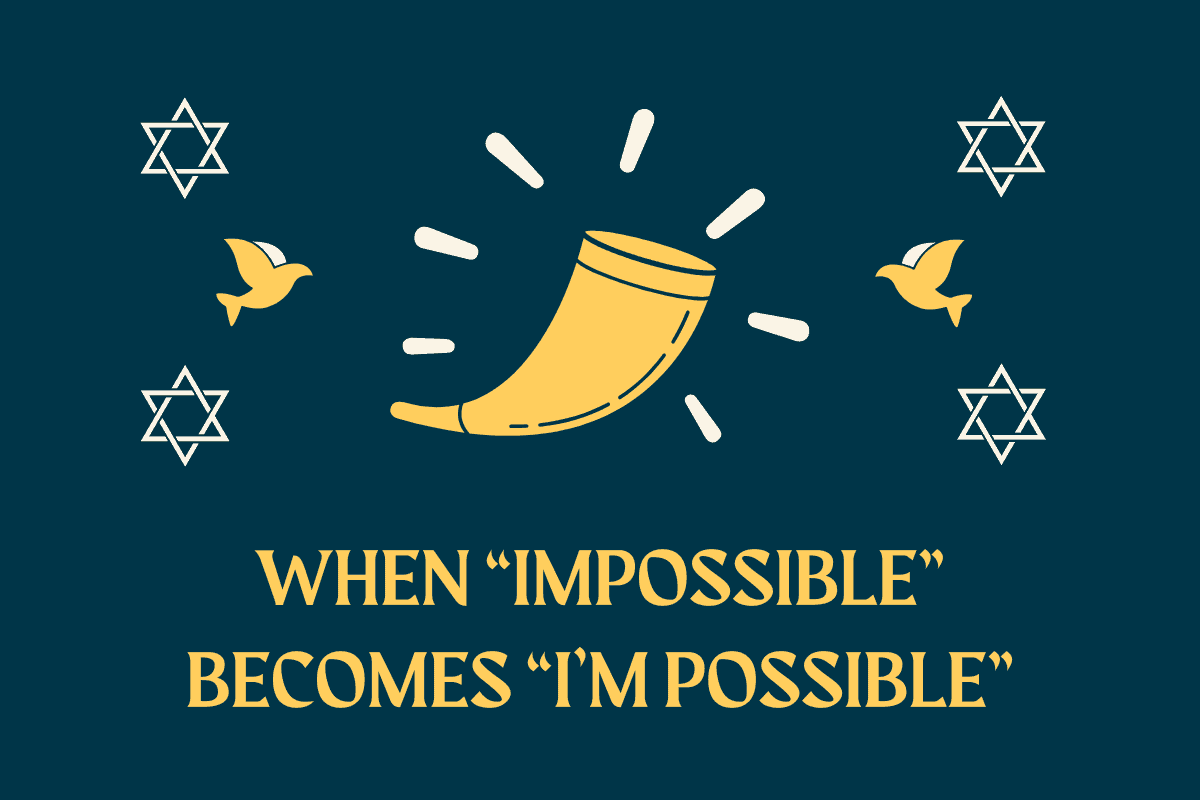
Look at a word we use far too easily: impossible. Now move the space. I’m possible. It sounds like wordplay, but it may hold one of Yom Kippur’s deepest teachings. Teshuvah is Judaism’s refusal to accept that a human being is ever a finished product.
The Talmud tells us about Resh Lakish, whose life had taken him far from the world of Torah before Rabbi Yochanan encountered him — and saw something Resh Lakish could no longer see in himself: potential, strength that could be redirected, a future that did not have to resemble the past. Resh Lakish changed his life and became one of the great Sages of his generation. His past was real. But it was not his destiny.
Most of us carry something we wish we could rewrite — a mistake, a broken relationship, words we wish we could take back. Judaism does not ask us to pretend those chapters were never written. It asks something more demanding: what chapter will you write next?
That question becomes sharper when we ask a harder one: what would happen if, suddenly, we lost what we complain about? What if the complicated relationship with a parent were no longer there? What if the job that exhausts us disappeared tomorrow, and we found ourselves missing it? Something strange happens when we imagine loss — irritation becomes gratitude. Ingratitude begins with the assumption that good things are inevitable. They are not.
Yom Kippur asks us to see our blessings with different eyes, not to frighten us, but to awaken us. Call your parents. Hold your children a little longer. Apologize while there is still someone to hear it. Say “I love you” before it is left unsaid. Be grateful for the ordinary Tuesday, the crowded table, the imperfect relationship, the friend who still answers the phone. Teshuvah begins when we stop assuming that tomorrow owes us a continuation of today.
Maimonides made one of Judaism’s boldest statements about human freedom: the power is given to every person to incline toward good and be righteous, if one so chooses. We are free — not free from consequences, not free to pretend our mistakes never happened, but free to decide what happens next. And yet we so often build a narrative about ourselves and live inside it for years: I am just like this. That relationship is beyond repair. It is too late. These may be the most dangerous forms of “impossible” — because eventually we stop recognizing them as assumptions and start treating them as facts.
When the final shofar sounds at the close of Yom Kippur, it can feel like an ending. Perhaps it is the opposite. There are relationships still waiting to be repaired, apologies waiting to be spoken, blessings we have failed to notice — and a version of ourselves we have not yet met.
Your past is not your destiny. Your story is not over. And the person you could still become is waiting for you to begin.
My wish for all of us this Yom Kippur is simple: I wish that we could truly become “I’m possible.” May we find the strength to forgive — the people who hurt us, the chapters we wish were different, and even ourselves — so that we do not need to lose what we have today in order to finally appreciate it. May the things that bother us stop having the power to keep us from the people and the blessings already in front of us.
Gmar Chatimah Tovah.
Rabbi Ari Oliszewski, Temple Emanuel, Virginia Beach.