
Yiddish was the first language Harriet Meier ever spoke.
Born in Germany to Polish Holocaust survivors who met in a displaced persons camp after World War II, Meier grew up hearing the language at home and among her parents’ friends. English eventually became her dominant language, but decades later, Yiddish still connects her to the people who shaped her childhood.
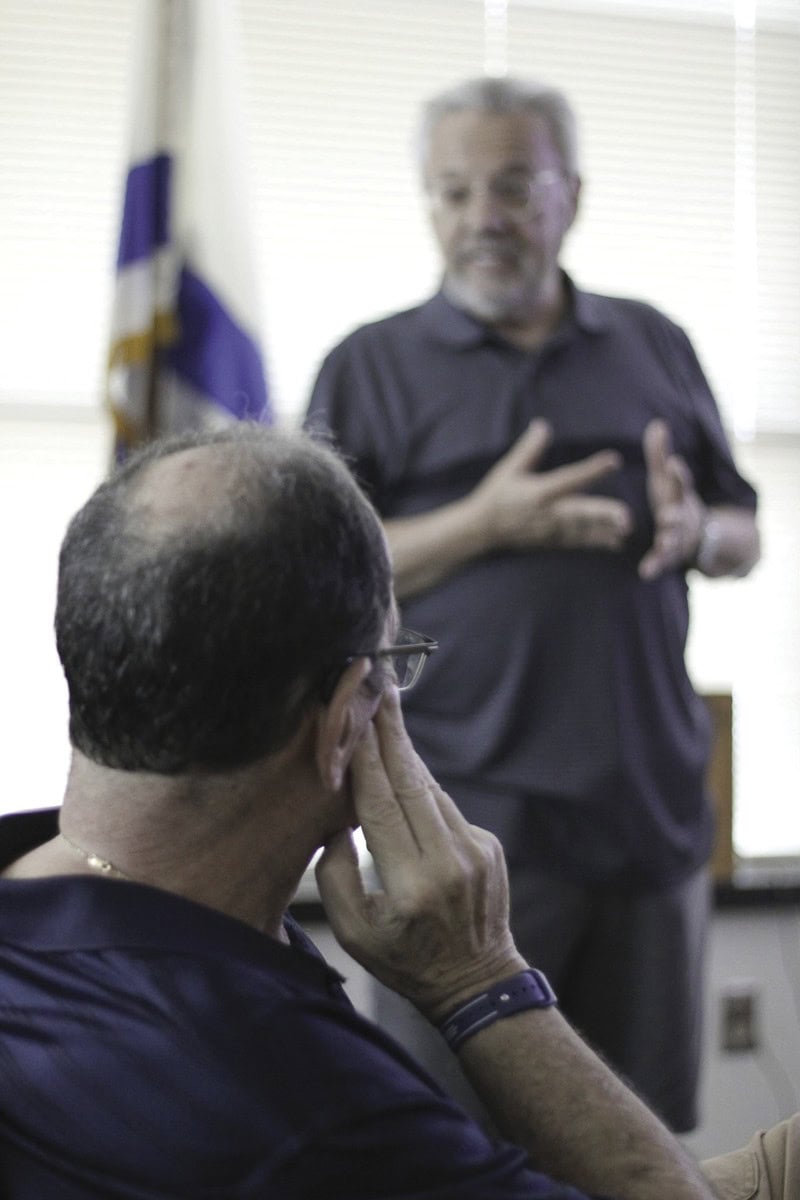
Today, she reconnects with that heritage at the Simon Family JCC’s Yiddish Club, where members gather monthly to explore the language through conversation, music, poetry, film, and more.
For Meier, Yiddish was always close to home, but with time and assimilation it became just out of reach.
“My parents would speak to me in Yiddish, but quickly I started answering them in English,” she says. After she entered preschool in the United States, where “everybody spoke English,” eventually “they just gave up and started speaking to me in English.”
Still, Yiddish remained present in her family’s life. Her parents and their friends continued speaking the language, sharing jokes, stories, and memories.
“Even amongst their friends, when they got much older, they were pretty much speaking English most of the time,” Meier says. “But they’d get together with friends and speak Yiddish.”
Though her father never taught her the language, she remembers him preserving it through music. “My father sang beautifully,” she says. “He would sing songs in Yiddish, and I remember a lot of them.”
Rabbi Israel Zoberman remembers a similar shift in his early years.
“When I came to Israel, I was about four years old,” Zoberman says. “We were told, ‘Don’t speak Yiddish on the street. No one will play with your kids if they hear them speak Yiddish.’”
Born in Kazakhstan in 1945 to Polish Holocaust survivors, Zoberman spent his infancy moving across postwar Europe before his family settled in Israel. At home, his parents spoke Yiddish – even though it wasn’t welcome outside.
In the years following Israel’s founding, Hebrew became a symbol of national renewal. Many immigrants embraced it while leaving Yiddish behind, seeing it as a language associated with exile, persecution, and the destruction of European Jewish life.
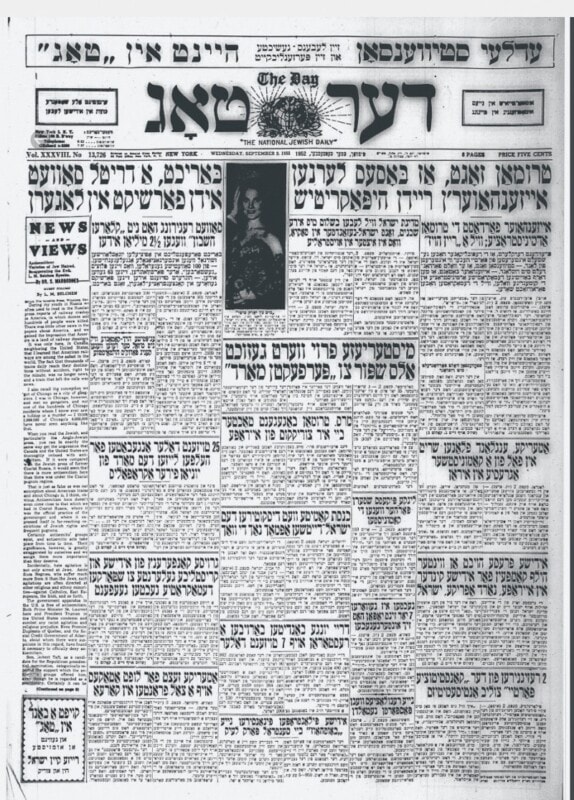
For club organizer Harry Graber, however, Yiddish was never a reminder of the past – it was his first language. He grew up speaking it on the Lower East Side, where Yiddish was part of everyday life in many Jewish neighborhoods.
Today, he sees the club as a way to show that Yiddish was not only a language of survival, but a language of creativity, humor, and culture.
“I want people to understand that the language is fun, that the language was used by people in very complex ways,” he says. “It was their everyday language… they used it for poetry, literature, and music.”
Now, once a month, members of the Yiddish Club gather at the Sandler Family Campus to read, laugh, and explore a language that once connected millions of Jews across Europe – and continues to connect them today.
Meier says part of what makes Yiddish so difficult to translate is its humor. “There are so many wonderful Yiddish expressions,” she says. One favorite saying she remembers is, “With one rear end, you can’t dance at two weddings.” Another colorful curse wishes someone would “grow like an onion with your head in the ground.”
With the Yiddish Club, they’re preserving not only a language, but the memories it carries — something deeply personal to club member Myrna Amdursky.
“What comes up is a part of my life that is now gone,” she says. “That was the language of my parents and grandparents’ generation.”
Similarly to Meier, Amdursky’s parents were set on helping their children fit into American life. She says her father intentionally chose not to teach the language to his children.
“He did not want me and my brother to learn Yiddish because he thought it would influence our English pronunciation,” she says.
Yiddish became what Amdursky calls, “a language for parents only” – something spoken among adults when they didn’t want children to understand the conversation.
But while some may assume the group functions as a language class, Amdursky says that’s not quite accurate.
Members discuss contemporary efforts to preserve and revitalize the language while exploring Yiddish films, music, and other forms of media.
Yiddish sayings are woven throughout the meetings, but the main point of the group is remembrance and discussion.
“It is not a structured learning environment. We are not studying Yiddish as a language,” Amdursky says. “We’re absorbing the culture.”
While Yiddish is often associated with prewar Europe and the Holocaust, Graber hopes the club can expand that understanding.
“Yiddish is so much portrayed, and to some degree rightfully so, as the language of pre-World War Two Europe,” he says. “But I tried to do some stuff that’s post-World War Two, so to see how it’s being used today.”
To Graber, preservation does not mean freezing Yiddish in the past. Instead, he sees it as a language that has evolved. “Not a language that died, but a language that has changed.”
“It is important to me for people to understand that the Yiddish language is not simply a folk language but a sophisticated language used by Ahkenazi Jews for one thousand years,” says Graber. “Hebrew was the language of the bible and Aramaic of the Talmud but Yiddish was the language of a civilization of Jews expressing itself in philosophical, theatrical, literary, scientific, academic and all other terms and formats reflective of a people successfully reaching beyond the limits of oppression.”
The Yiddish Club meets on the first Tuesday of each month at 1 pm at the Sandler Family Campus. Information: jewishva.org/Adults or contact Sarah Cooper at SCooper@ujft.org.