
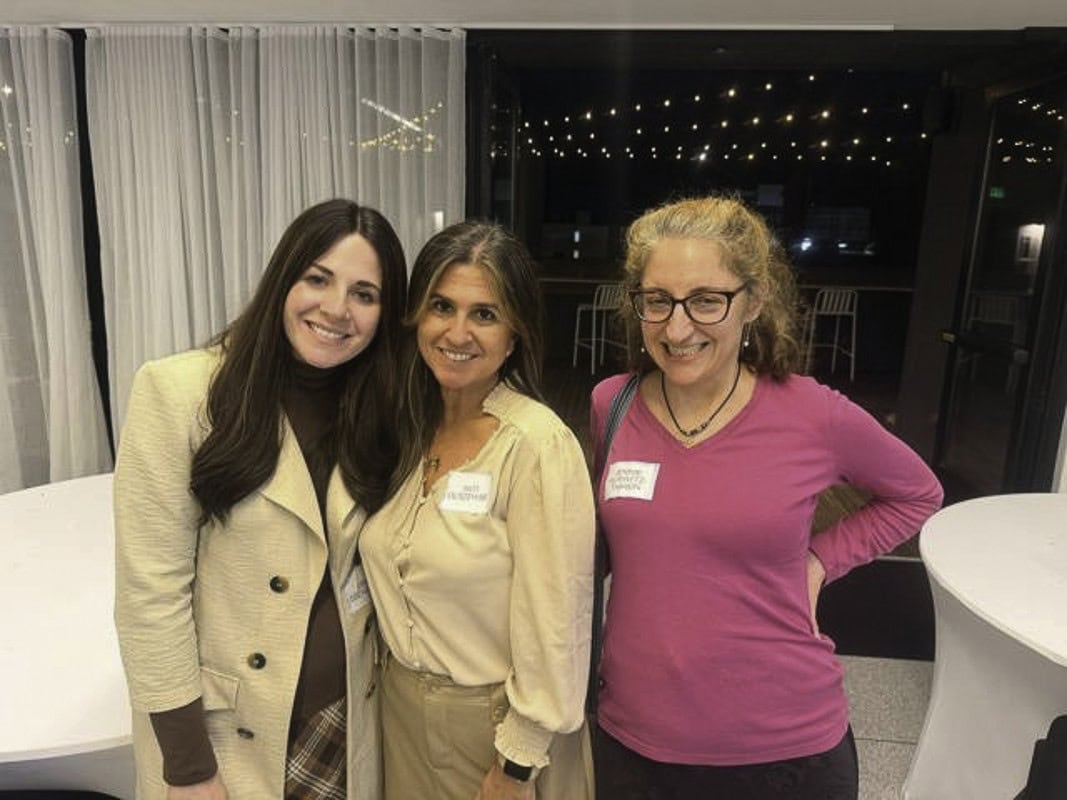
More than 50 women gathered on the top floor of the Assembly building in downtown Norfolk for the Lev Sara Bikkur Cholim Inaugural Dinner in March. Lev Sara Bikkur Cholim is a committee founded by Shari Berman, Shana Danziger, Liba Eisenberg, Dee Slone, and Michal Stein. Attendees enjoyed a dairy dinner catered by Cater613 while listening to speakers share how the project began and highlight the importance of the mitzvah of bikkur cholim.
Shari Berman opened the program by explaining the “why” behind the project. Lev Sara is named in memory of her mother-in-law, Shirley Berman, whose Hebrew name was Sara. Berman described how her mother-in-law dedicated her life to chesed, to bikkur cholim. In addition to her work as a social worker, she volunteered with an organization that supports people with cancer. Berman said she “felt this project would be a meaningful way to honor Shirley’s memory.”
In introducing Elise Wolf, the keynote speaker, Michal Stein noted that Wolf’s connection to Norfolk spans many years. Born in Norfolk to Benn and Jackie Richels, she noted that the community continues to benefit from the hard work the Richels invested in Norfolk’s Jewish community. As the principal of Bais Yaakov of Baltimore, Wolf has played a significant role in educating thousands of young Jewish women, including Stein, who highlighted the love, care, and devotion Wolf shows her students during their time at the school and long after graduation.
Wolf began by saying that when she researched the topic of bikkur cholim, “it never occurred to me how nuanced and how varied this mitzvah is.” She broke the mitzvah down into three parts: what it is, where it appears in the Torah, and the benefits of performing it. The word bikkur, she explained, means to check on someone and ensure that their needs are met.
Wolf shared a couple of stories stressing the benefits of bikkur cholim.
First, she told a story from the Gemara about the great first-century sage, Rabbi Akiva. When one of his students was absent for a couple of days and his classmates had not seen him, Rabbi Akiva suspected he was ill, as he was typically diligent and dedicated. When Rabbi Akiva visited him, he found drawn window shades and the room dusty. He immediately opened the windows to let in fresh air, changed the bed linens, and spent a few minutes speaking with his student. The student said to his rebbe, “You have given me life.” Wolf emphasized this Gemara’s lesson: when we neglect the sick, we cause great harm, but when we care for them, we give life.
Another story was about Rabbi Aryeh Levin, a revered figure in Jerusalem who passed away in the 1960s. Rabbi Levin regularly visited hospital patients. One day, the mother of a sick child approached him in tears, explaining that she could not provide for her son and that no one was caring for him. Rabbi Levin promised to add the boy to his list of weekly visits. After several weeks, the child remarked, “They’re finally paying attention to me, checking if I need anything.” When Rabbi Levin thanked the hospital staff, they replied, “If he is important to you, he must be important to us.” Wolf emphasized that the takeaway from this story is that when hospital staff see others showing care and attention to a patient, they are more likely to do the same. She said she has witnessed this dynamic herself during the many hours she has spent in hospitals with families.
Liba Eisenberg introduced the final part of the program. “Now we have ‘the what,’ the importance of this mitzvah. (But) what makes the biggest difference is not in what but in how we do the mitzvah.” Participants at each table spent about 10 minutes discussing pre-distributed questions, including: What is helpful—and what is not? What does it mean to show up without extracting information? How do we want people to feel after interacting with us? Several themes emerged: It is often more helpful to offer something specific—“I make soup; can I bring you some at 1?”—rather than asking a broad question like, “What can I do to help?” which may put the burden on the person who is ill. Participants also noted the importance of respecting privacy and not pressing for details about someone’s condition. Instead, the focus should be on offering time and conversation. Genuine care should feel natural and unforced. Visits should not be rushed; rather than arriving with an eye on the clock, one should be present and make the interaction about the other person. Ultimately, listening was highlighted as one of the most meaningful ways to support someone going through a difficult time.
Before leaving, attendees completed cards indicating how they could get involved in the project, such as cooking and delivering meals, and visiting hospitals or senior living facilities. Although the committee was initiated by members of B’nai Israel, its mission extends to serving anyone in need within the greater Tidewater Jewish community.
To participate as a volunteer or recipient of services, email levsarabikkurcholim@gmail.com, call 757-559-1409, or go to https://www.bnaiisrael.org/lev-sara-bikur-cholim.html.