
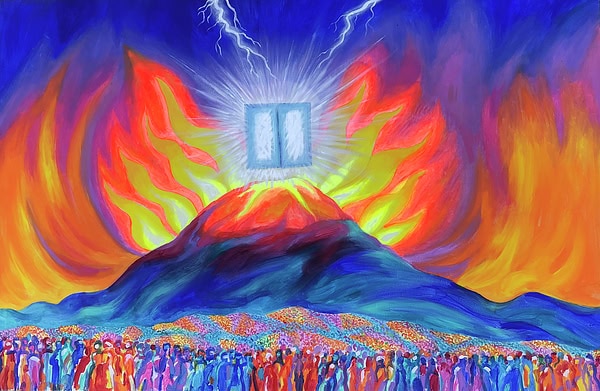
Every year, we count the Omer between Pessach and Shavuot. Seven weeks. Forty-nine days.
For many of us, it can feel like just another Jewish ritual quietly tucked between two major holidays. But this year, through Amy Lefcoe’s six-week class, On Our Way to Mt. Sinai, I realized something deeper: the journey itself is the point.
Pessach is not only about freedom from Egypt. It is about asking ourselves a much harder question: What am I still a slave to?
Maybe it is anger. Ego. Fear. The need to control outcomes. The need to always be right. Maybe it is judgment. Maybe it is the endless distractions that keep us far from who we want to become.
The Omer invites us into a process of refinement. Not perfection — refinement.
Week after week, we explored the idea that Judaism does not expect us to erase our difficult character traits. We are human beings. We were created with complexity. But we are also expected to work on ourselves constantly. In Judaism, personal growth is not self-help. It is spiritual work.
One sentence from the class stayed with me: “We are not what our nature is.”
That idea is both comforting and challenging. We may naturally lean toward impatience, arrogance, resentment, anxiety, or anger — but those traits do not define us. They are simply the material we were given to work with.
And perhaps that is why the people in our lives are there, too.
Sometimes the people who challenge us the most are also the people helping us grow the most. Judaism teaches that our relationships become mirrors for our character. They expose what still needs healing.
One of the strongest discussions we had centered around anger. Amy Lefcoe referenced the plague of frogs in Egypt: it began with one frog, but every time it was hit, it multiplied. Anger works the same way. Once we start “hitting the frog,” it grows bigger and louder and harder to stop.
And often, anger comes from ego — from unmet expectations, from feeling unseen, unheard, or not in control.
Judaism offers another path: humility.
Not humiliation. Not thinking less of ourselves. But recognizing that we are not the center of everything.
One insight I loved was: “Don’t take pride; take pleasure.”
We are not the creators of every success in our lives. We are simply “cashing the check” that God gave us the opportunity to receive. We are responsible for the effort. God is responsible for the outcome.
That shift changes everything.
Because once life becomes less about “me,” gratitude naturally enters the picture.
And gratitude is one of Judaism’s greatest foundations.
It begins every morning with Modeh Ani, thanking Hashem for returning our soul to us for another day. Gratitude appears throughout our prayers, our blessings, our traditions. We are constantly reminded to notice the good. To recognize that even difficult moments may contain opportunities for growth.
Lefcoe spoke often about bitachon — trust in God. Not passive trust, but active trust. The understanding that we still pray, try, work, and show up… while also recognizing that not everything is ours to carry.
We hold so much weight on our shoulders. But maybe part of spiritual growth is learning to put some of it down.
None of this is easy.
But perhaps that is exactly what the journey to Mt. Sinai is supposed to teach.
Receiving the Torah was never only about standing at the mountain once, thousands of years ago. It is about asking ourselves, every single year:
Who do I want to be when I arrive there?
More humble?
More grateful?
Less judgmental?
More trusting?
Closer to God?
Closer to the person I was meant to become?
The truth is, we are all still on our way to Mt. Sinai.
Still learning.
Still refining.
Still trying.
And maybe that is the holiest part of the journey.
For more information about classes offered by United Jewish Federation of Tidewater’s Konikoff Center for Learning, visit JewishVA.org/KCL or contact Sierra Lautman at SLautman@ujft.org.