Naturally curious creatures, children interact with the world around them through play. This instinctive engagement becomes even more pronounced in natural environments, where exploration is open-ended and sensory-rich.
As one study by the National Wildlife Federation found, children who play in nature “do so with more vigor, engagement, imagination, and cooperation than in wholly artificial environments, and the symptoms of attention deficit and depression are reduced.”
This philosophy was central to the vision behind the new playground on the Sandler Family Campus, which resembles a small woodland city more than a traditional play area.
“We wanted something much more natural than a traditional playground,” says Joe Frissora, Sandler Family Campus facilities manager.
Primarily designed to be used by Camp JCC campers and Strelitz International Academy’s students, the playground is another component of the Sandler Family Campus’ array of outdoor features – including the pool, Gaga pit, miniature golf course, tennis courts, and Marty Einhorn Pavilion.
“We wanted a playground that really allowed children to take safe risks and kind of create their own play,” says Elyssa Brinn, Strelitz International Academy’s director of the early years program. “There is no set right way to do anything, which is exactly what we wanted.”
Natural playgrounds are designed to foster cognitive, physical, and emotional growth in children while also strengthening environmental awareness. As with traditional playgrounds, they offer opportunities to climb, slide, swing, and crawl, but they also surround children with natural elements that help calm the nervous system and create a sense of ease.
“It just feels good to be out there and look at,” says Veronica Samonte, SIA assistant director of the early years program. “There’s just a calm to it.”
This shift also reflects a broader move at Strelitz toward inquiry-based learning. “Our philosophy is child-oriented and child-centered, and the play goes in the direction that the children take it,” Brinn says. “We’re just facilitators of that learning.”
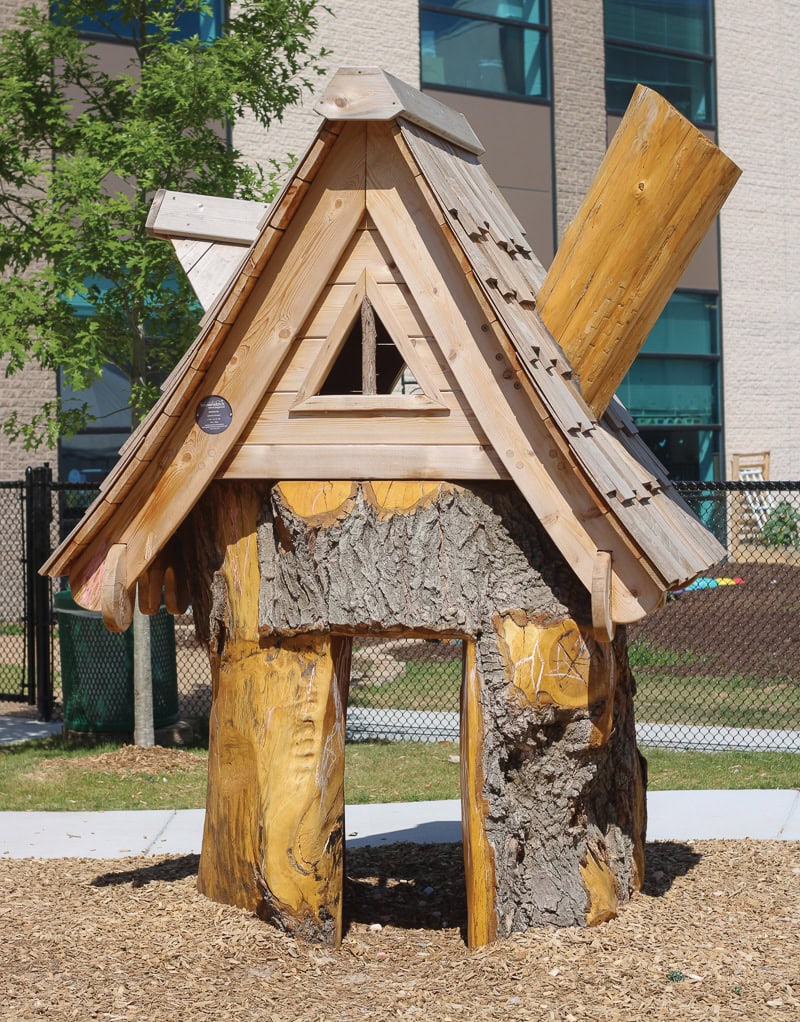
One look at the new playground makes its design clear. In some ways, the layout mirrors the old space, with a fence separating play areas by age. In the section for younger children, tree stumps are hollowed out into small playhouses topped with triangular wooden roofs. Logs are arranged in varied formations for climbing—some laid side by side, others set upright with monkey bars between them. Two small slides descend from a low hill, and additional stumps double as tables for toys. Nearby, children use bowls and spoons for sand play or build with wooden blocks from a self-serve storage cabinet.
On the other side of the playground, older children pile onto large woven green basket swings suspended from timber structures. Like the younger area, it includes large sand areas but also adds a water pump and more advanced climbing features. Chalkboards and music makers offer points of creative exploration. From the previous playground, only the paved pathways and tyke bikes remain, allowing children to move through the space as they would a small town.
Children use the variety of resources at their disposal to create worlds of play at their own discretion. “They have to problem-solve to move things around and make things work a different way, and they have to work together. It’s really, really cool to see,” Brinn says.
The open-ended nature of the new playground allows imagination to run freely. “I just like watching them use their brains to play,” says Carin Simon, SIA director of advancement. “The old school playground… it told you what to do. That’s what the structure was. With this one, they get to do what they want.”
Behind the design of the new playground was a complex construction process involving multiple contractors, site challenges, and long-term planning from campus leadership. According to Glenn Saucier, the former facilities director for the Sandler Family Campus, Bienenstock Natural Playgrounds was selected after reviewing several competing proposals.
What ultimately set Bienenstock apart was its clear understanding of early childhood development and the essential role of natural environments in shaping how children learn, explore, and make sense of the world around them.
Although the company was responsible for the design and installation of the play structures, the campus served as its own general contractor, coordinating multiple local teams to complete the project. “We got the landscapers, the concrete guys, the fence guys, and we coordinated all of that,” Saucier says.
From there, the project moved through design selection and into a phased construction process that stretched from early site preparation through final installation. Saucier estimates that the active build took place over roughly four months, though groundwork began earlier with excavation and soil preparation.
However, the project encountered significant infrastructure challenges, particularly related to a crack in the storm drain.
Rather than halt construction, the team adapted the design and repair strategy to keep the project moving.
Despite the challenges, Saucier describes the finished playground as a standout addition to the campus. “It’s probably the showcase around this area for a playground.”
What stands out most is not just the design of the space but the way children inhabit it. “The things that they are creating and doing… we’re surprised every single day when we go out there,” Brinn says.
Even features like the large woven swings were intentionally designed to support social development and encourage collaboration. “Not only is it allowing children to get the needs met that they need, but they also have to figure out how to work with four other children,” Brinn says.
The impact has extended beyond the children themselves. “I’ve noticed a new freedom, not just with our children, but our teachers as well,” Brinn says. “It’s really helped our teachers embrace the philosophy of watching the children and letting the children guide them rather than them guiding the children.”
Ultimately, the playground is exactly what it was designed to be: a place where imagination sets the boundaries and play is entirely their own.
Playground for Sandler Family Campus focuses on nature